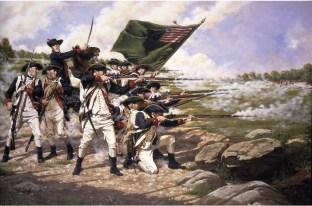
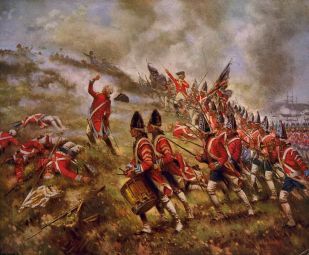
Meet the Author!

Exciting news! I have been invited to deliver a series of author talks and book signings in November at a Middle School in Lenexa, KS!

The 8th Grade class will be studying the American Revolution; I will be sharing some thoughts on life during the Revolution, and giving them the opportunity to learn more through the eyes of Gideon Hawke and Ruth Munroe!

This is the first such event to which I have been invited, and I am very excited, because it goes to the core of why I started writing historical fiction: to help young people find an interest in American History!

Soon there will be much more to follow!

Robert Krenzel Author Facebook page: https://www.facebook.com/RobertKrenzelAuthor

Gideon Hawke Novels Facebook page: https://www.facebook.com/GideonHawkeNovels/


Musical Inspiration

Sometimes my imagination needs a jump start. Sometimes it needs some help keeping it “in the zone.” Sometimes it just needs a taste of the historical period I am writing about to keep the juices flowing. At times like these music is my source for inspiration. I know some writers prefer to write in absolute quiet, but not me!

I have managed to find a number of albums from Fife & Drum groups; these are excellent for taking me back to the Eighteenth Century. I find these especially useful during the action scenes, when Gideon Hawke and his mates are trading shots with the British or Hessians. While in the Army I participated in enough ceremonies to understand the power of martial music over a group of soldiers, so when I wrote one of my favorite scenes, the fight on Breed’s Hill (a.k.a. the Battle of Bunker Hill), I had The British Grenadiers playing on a continuous loop. The effect was so profound I included a snatch of the tune into the text, and I got in the habit of including the “rat-tat-tat” of the drums urging the British forward.  Of course, when I write scenes in which the Americans have the upper hand, there is no substitute for Yankee Doodle! That song was born as a British insult toward the American “Provincials” but was embraced by the Americans and became a symbol of American resistance. Many a British soldier fell on the battlefield to the accompaniment of Yankee Doodle.

But it’s not all fifes and drums, of course! I also have a couple of go-to contemporary (-ish) groups and artists whom I can rely upon to help me focus. I find that Lord Huron, with their sweeping instrumentals, smooth vocals, and gritty lyrics help me put my world aside focus on Gideon Hawke’s world. (I am listening to them right now, in fact!) What’s more, I can always count on their song She Lit a Fire to help me get in touch with Gideon’s feelings for Ruth. On the other hand, I think Brother brilliantly captures the emotions that men feel toward one another as they face hardship or combat together; that song reminds me of the relationship between Gideon and Andrew Johnston.

When I need to slow things down a bit, or feel especially inspired, Sarah McLachlan never lets me down. If nothing else I find that her incredible talent helps me to de-stress. When I am exploring characters and relationships, Sarah’s music helps me get in touch with a completely different set of emotions. She also throws in a few curveballs; her song Monsters was one of the inspirations behind the character of Kate Scott, who makes quite a splash in my forthcoming novel A Nest of Hornets.

Of course, it was not all fun and games during the Revolution. War takes a toll, and I find that many of the songs on the Dire Straits album Brothers in Arms evokes those feelings of war-weariness and loss. (Yes, I realize I just dated myself, and I’m OK with that!) I feel the title song brilliantly communicates the feelings of brotherly love in extremis.

There are many more, of course. Were someone to browse my musical selections I am sure the term “eclectic” would come to mind (or perhaps something a bit harsher). Whether it’s rock or reggae, Buffet or the Beatles, AC/DC or the Maytals, it all has a place, and I am certain that the flavor of the music comes through on the pages. I hope my readers enjoy the beat!

I am curious to hear what music inspires other authors, or if readers have favorite background music to accompany a good a good book. What say you?


Robert Krenzel Author Facebook page: https://www.facebook.com/RobertKrenzelAuthor

Gideon Hawke Novels Facebook page: https://www.facebook.com/GideonHawkeNovels/

Juggling Projects

I have reached a dangerous and challenging time and place: the space between two novels!

Draft #3 of A Nest of Hornets is complete. My editor, and more importantly my wife, have given me some great ideas. Now I have a bit of fine-tuning to do before it is fully ready for publication. But in my mind, this story is nearly told. So my thoughts are drifting…

I have begun writing Gideon Hawke #4, A Constant Thunder. I am truly pleased with the 1000+ words I have thus far! And with my recent excursion to Saratoga is fresh in my mind I am full of ideas that are begging to be committed to paper. What to do?

The next few weeks will be fraught with tough decisions as I parcel out my precious writing time between two novels. The good news, I suppose, is that this is a pretty good problem to have!

Gideon Hawke Novels Facebook page: https://m.facebook.com/GideonHawkeNovels/

Historical Research: Books, Maps, Notebook, Sunscreen, and Bug Spray

What do you think of when you hear the term “historical research”? Many people would likely visualize a quiet library, or a stack of books, or even a computer monitor. I certainly use all of those, but when writing historical fiction I feel there is no substitute for visiting the scene of the action.

I have been fortunate in that at one point or another I have been able to travel to most of the sites I have written about, but my recent visit to the Saratoga Battlefield was by far the most satisfying visit for two reasons. First of all, the battlefield is well-preserved. The man-made structures have disappeared, and the vegetation has changed somewhat, but the topography is generally as it was 239 years ago. Secondly, I was able to thoroughly prepare for this visit as I had not prepared for visits to Trenton, Princeton, Washington’s Crossing, New Brunswick, and so on. That preparation was priceless.
Research 1

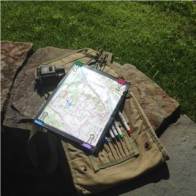
Tools of the trade

I had already read up on the Battles of Saratoga; there were many engagements in the Saratoga Campaign, but the “Battle” generally includes the actions on September 19th, 1777 (a.k.a. The Battle of Freeman’s Farm) and October 7th, 1777 (a.k.a. The Battle of Bemis Heights). Once I realized I would be able to make a trip to visit the site, I procured a topographic map of the area from My Topo. The My Topo site produced a map in a scale and format very familiar to me; through many years in the Army I used similar topographical maps to plan and navigate on several continents, so my “Saratoga Special” spoke to me in a very familiar language.


I read more, and used the nuggets of information in several books to better understand the timing and sequencing of events. By comparing my notes and the maps in the various books with my topographical map, I was able to narrow down the spacing: precisely WHERE various events occurred. The contour information and precise scale on the topographical map was critical here, as it helps make sense of lines of sight, ranges, and difficulties of the ground. When I thought I had it sorted out, I went so far as to sketch out the sequence of events on transparent overlays over the map, enabling me to visualize the ebb and flow of the fighting.

Then came the big day! Map, notebook, and camera in hand–and with generous applications of sunscreen and bug spray–I set out early to arrive at the Visitor’s Center as it opened. The center is small, and houses a limited but very nice collection of artifacts and dioramas, but I found the 20-minute LED Map presentation to be invaluable. Based on extensive studies of the battlefield and historical record, it corrected a few misperceptions and definitely enhanced my understanding of unit locations and the sequence of events.

Finally it was time to hit the road. I was able to follow trails and paths to find key locations
Author 6

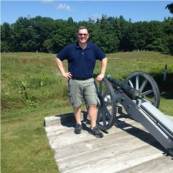
Balcarres Redoubt

where the battle unfolded. It was truly humbling to stand on the very ground where men like Daniel Morgan, Simon Fraser, Enoch Poor, at thousands of others fought gallantly for their respective causes, and where so many gave the last full measure of devotion. I am especially indebted to park Ranger Douglas Bicket, who clarified several points and helped me understand how the field had changed, and had not, since 1777.


Being particularly interested in the actions of Daniel Morgan’s Rifle Corps, I focused on retracing their steps as best I could. The vegetation around what was Freeman’s Farm made it a bit difficult to fully envision what Morgan and his men saw on September 19th, but that was a revelation in itself. In that broken, wooded, ground I could see how Morgan’s men were able to fire the first shots of the battle and then run headlong into the might of the British Center Column. To my even greater delight I was fully able to reconstruct the events of October 7th, especially the approach to and assault upon the

IMG_5434

Looking up the slope toward the Hessian positions

Breymann Redoubt. The books may not all agree with my interpretation, but knowing what the Rifle Corps accomplished that day, and having studied and used terrain as a professional soldier, I found myself sliding around the northern flank of the redoubt, into a shallow draw, with a steep slope leading up to the location of the Jäger Outpost and Hessian Light Infantry positions. Standing at the base of that slope, with one of the National Park Service’s white markers just peeping over the top, I was absolutely certain this was the way a tactician as astute as Morgan would have led his men. After I scaled the slope and stood inside what had been the Jäger Outpost, I was even more certain this was the spot where Morgan’s men actually swarmed over the Hessian defenses, precipitating the collapse of the British and German line and sealing the fate of Burgoyne’s Army. Of course I can’t be sure I got it 100% right, but if anyone disagrees with my interpretation I’d happily meet them on the field and have a friendly discussion about it; I think the facts on the ground would speak for themselves.
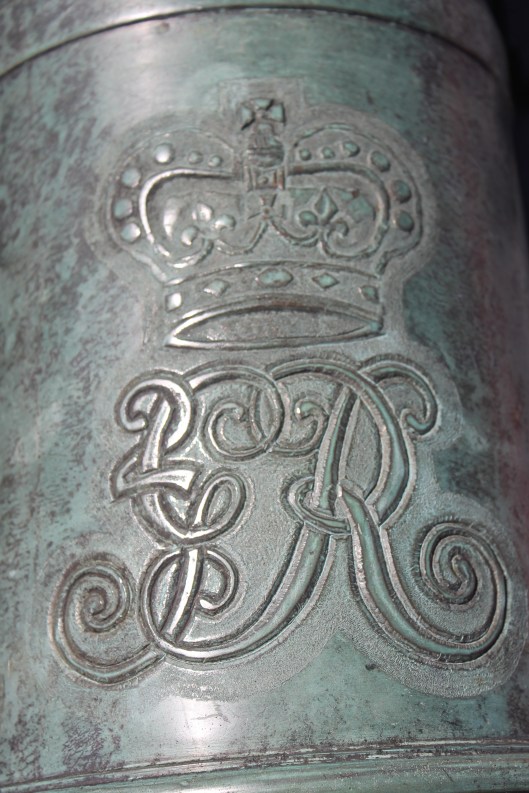
IMG_5419

One of His Majesty’s cannon


Happily, the only hazards I faced during my visit to Saratoga were dehydration, sunburn, thorns, and bug bites, all of which I am happy to report I overcame. 239 years ago, for a few hours, that hallowed ground was a much more dangerous place. I will dedicate the fourth Gideon Hawke novel to memory of those, on both sides, who braved shot, shell, and cold steel on the fields of Saratoga.

My Topo: http://www.mytopo.com/

Saratoga National Park: https://www.nps.gov/sara/index.htm

Gideon Hawke Novels Facebook page: https://m.facebook.com/GideonHawkeNovels/

Quill and Ink: Why Linear Tactics?

One of the common cultural images of the American Revolution involves lines of men standing fifty yards apart and trading volleys. To the modern observer, one of the first questions that comes to mind is: “Why?” Why would people stand there like that? Well, as usual, it’s complicated.

The Battle of Long Island

First of all, there is the question of firepower. A well-trained Eighteenth Century musketeer could get off roughly four shots per minute, with an effective range of less than one hundred yards. Skilled commanders would hold their fire the enemy was within fifty yards (“…until you see the whites of their eyes!”), to maximize the impact of the first volley. That first volley was especially critical because black powder weapons belched out great quantities of smoke, obscuring the target. Furthermore, muskets quickly fouled and had delicate mechanisms (a lost or broken flint immediately turned a firearm into a club), so it was a case of diminishing returns.

It was also necessary to keep soldiers under control. When placing so many soldiers in such close proximity, with loaded firearms, for safety’s sake it was critical to control who fired when. Otherwise, “friendly fire” and accidental shootings would have been even more common than they already were.

The threat of cavalry attack also demanded tight formations. Large cavalry formations could quickly close the distance to enemy troops and use their swords and shock effect to break up infantry units. To repel cavalry charges infantry units learned to form tight, three-deep squares, using musketry and bayonets to keep the horsemen at bay.

Considering these factors, there really was no other option than to keep the men close. The objective in combat is to impose one’s will on the enemy, and with black powder muskets the only way to generate enough firepower to physically stop a body of enemy troops from doing something was to form up tightly, get close, and “pour it on.” In most cases a high proportion of troops under fire from enemy musketry survived, although there were cases when units taken by surprise or poorly handled were annihilated. (Teaser: in my upcoming novel, A Nest of Hornets, a British grenadier company meets this fate at the Battle of Spanktown).

Battle_of_bunker_hill_by_percy_moranHaving said all that, combat in North America was different from combat in Europe. In the Americas distances were greater, troops less numerous, the ground more broken, and cavalry less prevalent. These factors forced commanders on both sides to adapt their tactics: there is compelling evidence that units on both sides adopted open formations, with up to a yard between soldiers, and also employed double, rather than triple lines. These adaptations made formations less vulnerable to incoming fire and enabled them to cover more ground. At Bunker (Breed’s) Hill in 1775, for example, the British used tight formations and attempted to trade volleys with the American militia, who fought from behind breastworks. As a result they suffered staggering casualties. They also learned to rely on bayonet charges. Their third attack at Bunker Hill was carried out with bayonets only, and succeeded. The British took this lesson to heart.

Starting with the Battle of Long Island the standard British tactics involved approaching to just within rifle range of American units and then rapidly closing the distance (often at a jog) until they could deliver a bayonet charge. This tactic served them well until the Continental Army gained enough experience and training to meet the British in the open field on something approaching equal terms. At Saratoga (1777) and Monmouth (1778) the Continentals proved that the British could no longer rely on the bayonet to always carry the day. But it would take three more years of bitter fighting until the Continentals and their French allies decisively proved the futility of the British cause at Yorktown.


Quill and Ink: Post Traumatic Stress in the American Revolution

This is a topic that is very important to me, but which can be very difficult to discuss.

As a career soldier I served on six operational deployments, including two tours in Iraq and one in Afghanistan. Each of those experiences left me forever changed; in some ways for the better, and in some ways, well, not. When I set out to write historical fiction set in the American Revolution I am not sure I realized how cathartic it would be for me. One thing is certain: after I dragged my protagonist, Gideon Hawke, through the wringer a few times I started to think, “This sixteen year-old is going to have a hard time dealing with all this.” Perhaps unconsciously this helped me to highlight the effects war has on its victims and participants.

For the record: the 1770s were a very different time, and the American Revolution was a very different war from what we experience today. There were a few factors which may have contributed to lessening the effects of what we now call Post-Traumatic Stress (PTS) on Eighteenth Century soldiers. First of all, society was different. There was more of a sense of community; people were more likely to pass their time in each other’s company than alone. Without television, radio, the internet, or mobile devices, people were less likely to seek “alone time.” As Sebastian Junger points out in his recent book, Tribe: On Homecoming and Belonging, the isolation of late-Twentieth and early-Twenty-First Century life has contributed significantly to the impact of PTS in our society.

Secondly, death and injury were far more common. In modern America a person can easily go through life happily munching away on poultry, pork, and beef without ever seeing an animal slaughtered. Likewise, except in certain areas it is an anomaly to see a dead human body. Again, Colonial/Revolutionary America was different. Infant mortality was much higher, life was shorter, and more people lived off the fruits of their labors. Certainly the industrialized meat packing industry was non-existent, so people were more accustomed to seeing blood spilled. People in general were less sensitive to some forms of potential trauma.

Furthermore, many American Revolutionary War soldiers served short enlistments, meaning that they would be exposed to military life for only a short time and then return home. They might serve in the war again, or they might not. Some served long stints, but most did not; we now know all too well about the compounding effects of multiple, extended, repeated exposures to trauma. Many of my friends have, like me, served long stints in dangerous conditions, over and over again. Some Revolutionary War soldiers, like Gideon Hawke, did serve for extended periods, and paid the price.

TombRegardless of how different society may have been in the 1770s to 1780s, people were still people, and war was still war. The human body reacted to danger and near-death in essentially the same way. So, when people in the 1770s and 1780s were exposed to trauma, many exhibited symptoms of would today be labeled PTS: insomnia, nightmares, nervousness, hypersensitivity, gastrointestinal issues, substance abuse, hearing voices, suicide, and so on. There were other manifestations which are less common today. For example, soldiers who had killed enemy combatants in hand-to-hand combat sometimes reported seeing the “ghosts” of their vanquished foes. But many of the symptoms would be very familiar to a modern combat veteran. Whatever the symptoms, science had not yet come to terms with PTS, and had not made the link between, for example, a soldier’s honorable service and behavior that could be viewed as bizarre if not frightening. The closest contemporary science may have come was applying the term “nostalgia” to this condition; it implied a link to homesickness, and did nothing to help those suffering from PTS.
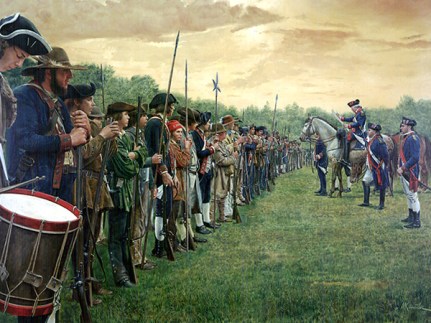
In the Gideon Hawke Series I have endeavored to show the effects of PTS in my characters. While he is often euphoric during combat, afterwards Gideon suffers from insomnia and nightmares; he is sometimes physically ill after an engagement; he is occasionally unable to control his emotions; he has contemplated suicide. His friend, Andrew Johnston, also suffers from insomnia, but in addition he sees the ghost of an Indian youth he stabbed to death many years prior. In my work in progress, her work in a military hospital is beginning to take a toll on Gideon’s love, Ruth Munroe. The war will continue to take a toll.

Believe it or not, it is hard for me to see these characters suffer from their invisible wounds (they do live in my head, after all). But in spite of any sympathetic reservations I might have, I feel obligated to see to it that they suffer, if only to honor the invisible wounds suffered by so many of my brothers and sisters in arms. Myself included.

To experience the effects of Post-Traumatic Stress through the eyes of Gideon Hawke, I suggest reading Times That Try Men’s Souls. https://www.amazon.com/Times-That-Try-Mens-Souls/dp/1635030420/

To learn more about the effects of Post-Traumatic Stress in modern combat veterans, or to get help for yourself or someone you love, I strongly recommend the non-profit organization Invisible Wound. https://www.facebook.com/InvisibleWound/

Quill and Ink: The Importance of the Declaration of Independence

I suppose that for some people it might go without saying that the Declaration of Independence was important. Most people probably don’t think much about it. But aside from being one of the most critical documents in defining the idea of “America” it was also a critical step in winning the War for Independence. On this 240th Anniversary of its signing, it’s worth taking a look at why it is so important.

Kings and queens tend to not be fond of rebels. The political landscape of Europe in 1776 was much different than it is today: revolutions had not yet swept the royals from power. While some nations (Britain, for example) were constitutional monarchies, most were, frankly, dictatorships. While many European countries considered Great Britain an external threat, popular revolutions at home were an even greater internal threat, so supporting a bunch of upstart colonists on the far side of the Atlantic in an illegitimate revolt against their lawful sovereign might inspire people closer to home to take up arms themselves.

The Declaration of Independence changed all that. By laying out American grievances, it made the case that King George and Parliament had violated basic American rights and thus forfeited their own legitimacy. Friendly nations need no longer concern themselves with a band of rebels; they could now choose to embrace a young nation fighting to preserve its independence from a tyrannical power. This was altogether more palatable in the royal courts of Europe.

The Declaration of Independence also complicated things for the British. When the Howe Brothers (General and Admiral Howe, respectively commanders of Crown Land and Naval forces in the Americas) arrived in New York Harbor in 1776 they were empowered to negotiate peace with the colonies. But there were no more colonies. By formally breaking the political bond to London, the Americans had “crossed the Rubicon,” and the Howes’ peace feelers consistently snagged upon the question of independence. The Americans considered independence non-negotiable; the British considered it totally unacceptable. These irreconcilable differences could only be resolved on the field of battle. Not until 1781, at a place called Yorktown, would the Americans (and their French Allies) finally convince the British that American Independence was here to stay.

Finally, about those troops who did the convincing for Washington: they needed something to believe in. It has become a bit cliché to say that soldiers fight for each other and not for a cause. But when you read firsthand accounts of the Revolution, you find that many of the men and women involved believed passionately in the American cause. Prior to July 4th, 1776, it was still conceivable that things could return to the status quo ante bellum. After July 4th, 1776, nothing would ever be the same again. The American would defend their independence or fail striving valiantly. Liberty or Death.

Kunstler_reading-the-declaration-of-independence-to-the-troops

Reading the Declaration of Independence: by Mort Kunstler

In the midst of barbecue, baseball, and fireworks, I encourage you to think for a moment about the men of the 1st Continental Regiment, who on July 4th, 1776 were posted at Gravesend on Long Island, monitoring the British invasion fleet anchored in New York Harbor. When, a few days later, they were read the Declaration of Independence for the first time, they were within cannon range of the most powerful military in the world, and they knew they would pay with their blood, sweat, and tears to enforce that Declaration. But they, with the help of hundreds of thousands of their comrades, did ultimately succeed in enforcing it. Let’s give thanks for their courage and dedication.


To learn more about the effect of the Declaration of Independence, and the darker days of 1776, I suggest reading Times That Try Men’s Souls.

https://www.amazon.com/Times-That-Try-Mens-Souls/dp/1635030420/

Spring arrives with inspiration in tow

It’s time to mow the lawn again. Some would consider that a bad thing, but I find it enjoyable. For one thing, I plug in my earbuds and enjoy some tunes, but more importantly, I get some of my best story ideas while walking back and forth across the yard.

This past week while about halfway through my front yard I had a flash of inspiration for Chapter 7 of A Nest of Hornets; an excellent plot point to bring a few threads together and perhaps build some suspense. Excellent!

Fortunately I am generally able to remember these ideas I generate while mowing. I dread the day, though, when I get multiple ideas. Maybe I should start mowing with my writer’s notebook in my pocket!

A new battlefield

Yesterday I finished Chapter 4 of A Nest of Hornets. In past novels I have placed my main character, Gideon Hawke, on many different battlefields. This time Gideon’s battlefield is very different: it is a dining room table in an elegant mansion, and he’s not sure who the enemy is…he’s not even sure there is a battle at first! Usually Gideon fights under the watchful eye of his friend, Andrew Johnston, but in this battle his only ally is his love, Ruth Munroe. Fortunately she is better prepared for this fight than Gideon!

While A Nest of Hornets remains deeply rooted in the history of the American Revolution, the plot gives me much more room to explore characters and dive into the divisive political tensions  that made the American War of Independence a civil war as well as a political revolution. I am enjoying it immensely!

Gideon’s Dilemma

I have been writing about Gideon Hawke for some years now. When I last wrote I left him hanging–huddled against a river bank in December, 1776, fending off the Hessians so Washington’s Army could continue its retreat to the Delaware.

Aside from the fact that people are trying to shoot him, Gideon has a problem; he is deathly afraid of losing anyone else close to him. His desire to protect those he loves is in direct conflict with the need to fight a war. To win in combat, one must often dare greatly, and daring can come at a heavy price. That is a lot of weight to rest on the shoulders of a seventeen-year-old!

I have felt this kind of conflict myself, both as a soldier and as a husband and father; frankly I have felt it most pointedly as a Dad. I can not protect my kids from everything, but I have to let them try to fly. It’s terrifying! But as heartbreaking as it is to see them fail, more often than not they SOAR, and that’s a glorious sight!

I sure hope Gideon learns that lesson!