The Forage War

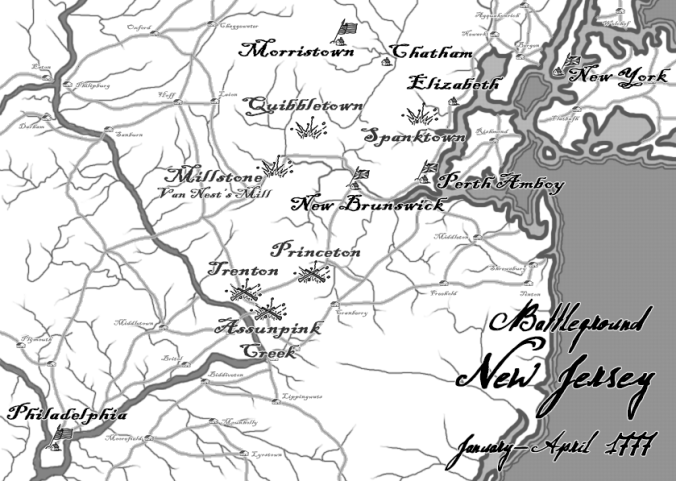
The British plan for the winter of 1777 had been to disperse their brigades across New Jersey, where the units could live off the land to augment the tenuous cross-Atlantic supply line. George Washington’s recently proven proficiency at destroying isolated brigades made this plan untenable, so the British and their German allies retreated to a few massed positions in New York and New Jersey. This gave them security, but left the countryside in the hands of the Jersey Militia, who had been freshly galvanized by the American victories in the Ten Glorious Days. Now the British and Germans would have to send out fighting patrols in ever increasing numbers to forage for food and fodder. These foraging parties made attractive targets for increasingly large swarms of militia, soon reinforced by Continental troops.

nj

Here are just a few of the 50-60 “skirmishes,” with the forces involved:

  • January 6th: Springfield, NJ. A force of 50 Waldeck (a German principality) infantry and a few British light dragoons ambushed and captured. This action precipitated the British abandonment of Elizabethtown (modern Elizabeth, NJ).
  • January 20th: Van Nest’s Mills (Millstone), NJ. 500 British, reinforced with with artillery, were attacked by Brigadier General Philemon Dickenson and about 400 militia, reinforced by a company of Continental riflemen. The British were driven off with heavy loss, to include a wagon train and several dozen head of cattle.
  • February 1st: Drake’s Farm. A force of about a thousand British and Hessian troops, to include elite battalions of light infantry, grenadiers, and highlanders, attempt to set a trap for an American force. When the 5th Virginia Regiment tries to capture a small party of British foragers, they are surprised by the entire British force.  The Americans launch a bayonet charge which breaks the grenadier battalion and buys them time to make good their escape.
  • February 23rd: Spanktown (Rahway) NJ. Nearly 2000 British regulars under the command of Lieutenant Colonel Charles Mahwood, the British commander who nearly won the day at Princeton, attack a small American foraging party. As they launch what they expect to be a final assault they are ambushed by nearly 2000 previously hidden Continental troops. The British are driven from the field and pursued back to their fortifications in Amboy.

The Continental troops gained experience and confidence from these encounters. They would later put their new-found expertise to good use at Brandywine, Germantown, and Saratoga.

The British and Germans realized that this was going to be a long, hard war. Perhaps a few of them began to develop a new-found respect for their ragtag opponents. If nothing else, it seemed in the words of one British officer that an outing into the New Jersey countryside was like walking into “a Nest of Hornets.”

You can experience the Forage War from a participant’s perspective in Gideon Hawke #3: A Nest of Hornets!

A Nest of Hornets on Amazon: https://www.amazon.com/dp/B01NBI511Q/

Ten Glorious Days!

December 25th, 1776 through January 3rd, 1777: ten pivotal, and glorious, days in American History.

The second half of 1776 very nearly saw the British and their Hessian allies crush the newly independent United States. Some of the American troops on Long Island learned of the Declaration of Independence while they were within sight of the British fleet anchored in New York Harbor. A few weeks later the British would overwhelm the American defenses on Long Island, triggering the first in a series of retreats that would see Washington’s Army nearly melt away; when the remnants finally crossed the Delaware River into Pennsylvania, Washington had immediately available only about 10% of the force he had in August. But “The Old Fox” did not give up. He set to work reconstituting his army, calling in detachments, seeing to it the sick and wounded were nursed back to health, persuading troops to stay with the colors, calling upon Congress and the states for reinforcements, and restoring morale: he ordered Thomas Paine’s The American Crisis read to the troops.

These are the times that try men’s souls. The summer soldier and the sunshine patriot will, in this crisis, shrink from the service of their country; but he that stands by it now, deserves the love and thanks of man and woman. Tyranny, like hell, is not easily conquered; yet we have this consolation with us, that the harder the conflict, the more glorious the triumph. What we obtain too cheap, we esteem too lightly: it is dearness only that gives every thing its value.

Washington knew that having an army was not enough: in the dark times at the end of 1776, he had to DO something with that army to give his countrymen hope. He knew he could not confront the enemy on even terms, but he also knew that the British and their Hessian allies had grown complacent in victory. He looked for a weakness, and found it across the River: in Trenton, New Jersey.

The Hessian brigade stationed in Trenton was alert, disciplined, and well trained, but it was increasingly isolated. On the night of December 25th, 1776, in a blinding snowstorm, Washington personally led his most reliable units across the ice-choked Delaware and on toward Trenton. None of the supporting attacking columns managed to cross the river, but Washington drove the main force on, and just after dawn on December 26th his men surged around Trenton. After a short, sharp fight most of the garrison surrendered. Only a few Hessian jaegers and British dragoons escaped, because they fled at the first alarm. Now isolated himself, but having won a precious victory, Washington withdrew back across the Delaware before the British could counterattack.
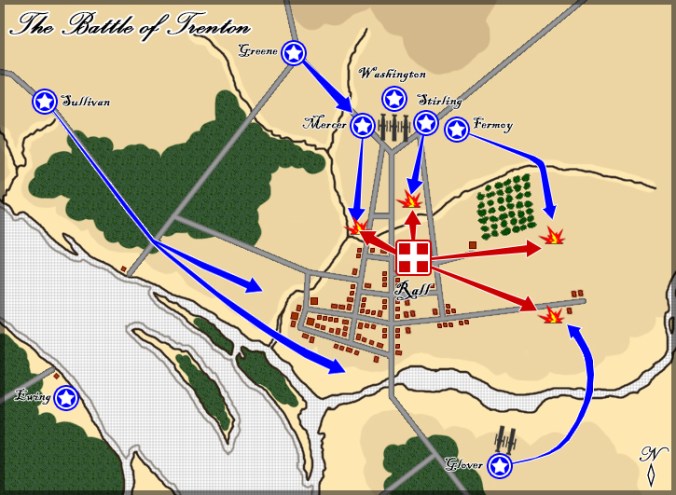
battle_of_trenton

The enemy response bordered on panic. The British command pulled in their far-flung garrisons across New Jersey and assumed a defensive posture, giving Washington total freedom of movement. Seeing another opportunity, Washington crossed the Delaware again and took up defensive positions along Assunpink Creek, just south of Trenton. When her learned that British General Charles Cornwallis was on the march toward Trenton, Washington deployed a screening force to the north to find and delay Cornwallis: this force included the First Continental Regiment, commanded by Colonel Edward Hand. Once the enemy appeared just south of Princeton Hand took command of the screening force; falling back from covered position to covered position his men slowed the British to crawl and inflicted galling casualties, buying time for the main force to improve the defenses on Assunpink Creek. As night fell Hand’s force fell back through Trenton and scrambled across the only bridge. The British attempted to seize the bridge, but the attackers were swept away by a storm of musket and cannon fire. Cornwallis’ force settled in for the night, prepared to renew the attack in the morning.
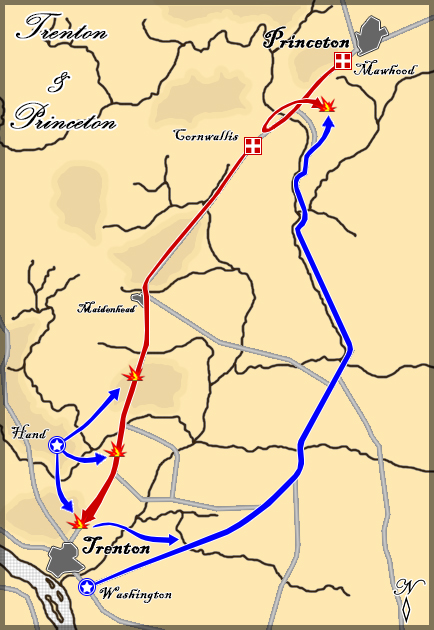
princeton_and_trenton

Washington had learned a great deal since Long Island. He knew Cornwallis would attempt to outflank him in the morning, and he knew that maneuver would probably succeed. So, he left a small force to keep the watch fires lit, make noise, and fire the occasional cannon; with the rest of his army Washington quietly marched away in the dead of a pitch black night, slipped around Cornwallis’ flank, and marched northwards toward Princeton.

Cornwallis had been so confident he had summoned most of the Princeton garrison, under Colonel Charles Mahwood, to march to Trenton. Part of Washington’s force, under Hugh Mercer, ran into Mahwood’s men, and a fierce fight ensued. Mercer was killed, his brigade broken, and Mahwood nearly broke the American line, but Washington rallied his men, and the line held long enough for another force, including Hand’s riflemen, to fall upon the British left flank. Mahwood’s units broke and ran, and while some of Washington’s force hunted them down, the rest moved into Princeton to capture the rest of the garrison. When Cornwallis finally arrived at Princeton, Washington’s force was on the road to the relative safety of the rugged terrain around Morristown with prisoners, captured guns, and loot in tow.

princeton

In ten days what seemed to be a defeated force had turned the tables, knocking two brigades out of the enemy order of battle, but more importantly breathing new life into the American cause and sowing fear in the hearts of their enemies. The New Jersey militia came out in swarms, and the British soldier had to endure a long, bitter winter marked by cold, hunger, and constant danger. In order to feed themselves, the British and Hessians would have to venture out into the Jersey countryside, where they knew their enemies were waiting in ambush. There would be many more battles to come.

To see the Ten Glorious Days from the perspective of one of the participants, check out Times That Try Men’s Souls!

Artwork by Ben Kloeppersmith

Washington Crossing State Park: https://www.nps.gov/nr/travel/delaware/was.htm

The Old Barracks Museum, Trenton: http://www.barracks.org/

Princeton Battlefield Society: http://www.theprincetonbattlefieldsociety.com/
Rowing Upstream: revised

A few weeks ago I discussed my realization that Gideon Hawke and cohorts would travel by water, up the Hudson River, to join the effort to check the British north of Albany. It is amazing what a little research will do to clarify things!

More detailed research revealed that Morgan’s Rifle Corps was not at Hackensack, as I had thought they were, when Dan Morgan received the order to move north. They had if fact been marching up and down New Jersey as Washington tried to guess what the main British army, under Howe, was up to. Until it became clear Howe was sailing away from the Hudson, Morgan and his men were sent hither and yon based on perceived threats. Based on correspondence between Washington and Morgan it appears the Rifle Corps was in the Trenton-Princeton area when Washington ordered them to join the Northern Department.

In the summer of 1777 the Royal Navy controlled New York Harbor and the nearby waters; it could also make incursions up the Hudson, so Morgan’s men would have had to embark some distance upriver. In fact, Washington specified they march to Peekskill, where transportation would await.

In the 1700s the Hudson was easily navigable as far north as Albany, so Morgan’s troops likely sailed on Hudson River sloops for much of the journey. Beyond Albany river traffic would have relied on bateaux. David Manthey, captain of the replica bateau DeSager, made me aware of the details of the military supply chain on the upper Hudson, consisting of relays of bateaux.

Now I can much better visualize the mechanics of the Provisional Rifle Corps’ journey to its meeting with destiny. What’s more, with a little additional research, I can bring that journey to life for my readers.

David Manthey’s Bateux Journey page: http://www.thebigrow.com

A Nest of Hornets Update

It is exciting to see A Nest of Hornets on the market—it is even more exciting to see that people are buying it!

I think readers will find much of Gideon Hawke #3 very familiar: Gideon and Ruth are back, as are many other characters. Gideon and the lads are at it again, this time they are working in conjunction with Continental and militia troops to harass and disrupt British foraging efforts in New Jersey in the winter of 1777. Gideon finds himself in charge of his company, planning and coordinating with senior American officers to create maximum havoc among the British ranks.

This is where A Nest of Hornets is a departure from the first two Gideon Hawke Novels: much of the action takes place in meetings and dinner parties, and Gideon must quickly learn to navigate “battlefields” very different from those he has come to know. Fortunately Ruth is much more comfortable in social settings, and she is able to guide Gideon around many hazards and pitfalls. These events allowed me to explore the Gideon-Ruth relationship in depth, and I think readers will enjoy seeing that relationship put to the test.

The greatest challenges Gideon and Ruth face come in the form of a married couple: Lieutenant Colonel “Black Dan” Scott and his wife, Kate. Dan is an efficient and ruthless New Jersey Militia officer who appreciates Gideon’s tactical acumen, but differs greatly from the young rifleman when it comes to the morality of killing prisoners. Kate Scott’s battlefield is the dining room and parlor: she chafes at the rustic lifestyle into which the war has forced her, and she takes an unhealthy interest in Gideon.

The plot literally thickens when it becomes apparent the British are being forewarned of American plans. As they find their way through the ins and outs of headquarters and societal politics, Gideon and Ruth must constantly be aware of a traitor in their midst. Will they uncover the plot, or will the spy’s treachery cost them their lives? A Nest of Hornets challenges Ruth and Gideon as they have never been challenged before.

To find out more, get a copy now! The current low prices of $2.99 (Kindle) or $8.99 (Paperback) will only last until the New Year!

Which brings me to my last point: I wonder who will post the first review?

A Nest of Hornets on Amazon: https://www.amazon.com/dp/B01NBI511Q/

A Nest of Hornets is now available!

The day has come at last! A Nest of Hornets is available for purchase on Amazon!

anh-cover-_frontSet in New Jersey in the winter of 1777, the third novel in the Gideon Hawke Series finds Gideon and his comrades immersed in the “Forage War.” Struggling to feed their men and horses, the British command launches forays into the Jersey countryside to seize supplies and livestock. The Continental Army and New Jersey Militia, eager to fight after their victories at Trenton and Princeton, resist the British at every opportunity.
Gideon and Ruth find that not all battles occur in the field. They find themselves enmeshed in conspiracies: someone is alerting the British to American plans, and Gideon’s successes bring him and Ruth into the company of some questionable characters. Will Gideon escape death in battle, only to be murdered by a treacherous colleague?

Get a copy now! The low prices of $2.99 (Kindle) or $8.99 (Paperback) will only last until the New Year!

A Nest of Hornets on Amazon: https://www.amazon.com/dp/B01NBI511Q/

The Plot Thickens: Rowing Upstream

As I waited to receive the proof copy of A Nest of Hornets I found myself inevitably drawn to working on Gideon Hawke #4, A Constant Thunder. I have already written several scenes, or at least the shells of those scenes, but I still have a lot of work to do on sketching out the flow of the novel. I had identified the chapters and was trying to flesh one of those chapters out when inspiration struck with a glance at a map.

It is no secret that Gideon Hawke will find himself in Daniel Morgan’s Provisional Rifle Corps, and thus will move north to confront Burgoyne’s “Canadian Army” in late summer of 1777. I had intended to focus one chapter on the movement north. I had a sketchy idea that there were boats involved at some point in that undertaking, but I had not yet tried to envision how that journey looked. So, last week I sat down to try to sort out how Morgan’s Rifle Corps got to the Albany area.

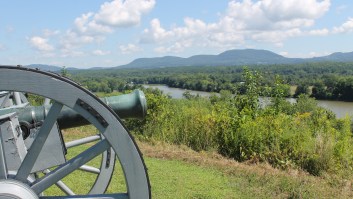
Hudson emplacementI knew the destination, so the next step was to identify the starting point. In poking around I discovered that Morgan’s headquarters was in the Hackensack, New Jersey area around the time Washington ordered Morgan to join the Northern Department. Having start and end points, I looked at the map and was hit with a blinding flash of the obvious: Hackensack and Albany both lay along the Hudson River. Given the primitive condition of the American road network in the 1770s, the fastest, cheapest, and easiest was to get five hundred men and assorted family members the roughly 130+ miles between these two points would have been to move straight up the Hudson.

The watercraft of choice in late Eighteenth Century America was the bateau: a flat-bottomed, shallow-draft vessel ranging in length from under twenty to over eighty feet in length. These craft carried both passengers and cargo, could maneuver in shallow water, and were relatively easy to transport overland. They could be propelled by sail, pole, or oar, and were critical to commerce and transportation in Colonial and Revolutionary America.

Before this I had never paid much attention to the lowly bateau, even though it features prominently in any discussion of the Saratoga Campaign. But now I find myself rearranging A Constant Thunder to include several chapters describing a bateau journey upstream. Not only will this be a great way to highlight a little understood aspect of life in Revolutionary America, but it will also serve as a metaphor on several levels. Without giving too much away, I am thinking about questions like: Who is in that boat with Gideon? What challenges does such a journey present? What other challenges might Gideon and his fellow characters face? What other life journeys might Gideon be on? What awaits at the end of the journey? What goes through a young man’s mind as he sails (or rows) day after day? Is this journey a trial, a quest, or both?

Writing historical fiction can be full of surprises. Occasionally a seemingly inconsequential bit of research can turn your story on its head. In this case, a glance at a map opened up an entirely new adventure.

Robert Krenzel Author Facebook page: https://www.facebook.com/RobertKrenzelAuthor

Gideon Hawke Novels Facebook page: https://www.facebook.com/GideonHawkeNovels/

Update: A Nest of Hornets is now officially a book!

At long last I am holding a proof copy of A Nest of Hornets!

anh-cover-_frontAfter months of researching, writing, rewriting, editing, rewriting some more, and even designing the cover, what was once an idea has become something tangible: a novel.
The next steps? Check, check, and check again! I have a trusted agent (my father-in-law) going through it page-be-page. I also had Ben, my incredible graphic artist, take a look and approve the print quality of his beautiful maps.

Next I get to read my own book, cover to cover: ultimately it is up to me to decide what must be fixed. Does the cover look right? (I love it!) Did I get the width of the spine correct? (No…not quite. I will have to adjust that) Is the interior the way I envisioned? (So far) Does the “cream” colored paper really go easier on the eye and remind the reader of bygone days? (Yes, I think so) Are there typos? (Still checking)

I already found one minor issue, and I am certain I will find a few more things. Hopefully they will be all be quick fixes, and A Nest of Hornets will be available in time to be an excellent stocking stuffer! (Which reminds me…I have to check and make sure the 6” x 9” trim size really does fit in a stocking!)

In the meantime: Happy Thanksgiving!

Robert Krenzel Author Facebook page: https://www.facebook.com/RobertKrenzelAuthor

Gideon Hawke Novels Facebook page: https://www.facebook.com/GideonHawkeNovels/

Sharing the Love!

Yesterday I had the opportunity to deliver an author talk to the 8th Grade Class at Mill Creek Middle School in Lenexa, KS. The students are about to begin learning about the American Revolution in their Social Studies class, so a discussion about historical fiction set during the Revolution worked in nicely with their coursework.

It was a real treat to be able to discuss my background, my passion for history, my writing process, and what I have learned about life in the 1770s. I mostly focused on my methodology for writing, sharing the amount of research I do, and then how that research translates into a timeline, an outline, chapters, scenes, and ultimately a manuscript. I also discussed when and how I write and the importance I attach to both outlining and capturing ideas when they hit me. I also emphasized the importance of editing and re-writing. In addition I was also able to give some insights into what life was like for a young man or woman growing up in the 1770s.

Overall it was a great occasion to share a bit about the ups and downs of writing. One young lady even asked if I had any advice for aspiring writers, and I was able to share a few hard-won lessons. As an added bonus, a good number of the students bought copies of This Glorious Cause and/or Times That Try Men’s Souls and had me sign them. It was wonderful to be able to interact with a few of the students one-on-one. It was especially rewarding to chat with one young man who wanted to read the Gideon Hawke Series because he loves learning about the American Revolution. I hope I am able at least in some small way to stoke the fires of his passion!

Robert Krenzel Author Facebook page: https://www.facebook.com/RobertKrenzelAuthor

Gideon Hawke Novels Facebook page: https://www.facebook.com/GideonHawkeNovels/

Elections and the Cost of Freedom

During my time in the military I had the great privilege of planning and/or providing security for elections in Bosnia, Kosovo, and Iraq. Each of these places had a history of totalitarian dictatorship, and it was truly moving to see men and women celebrating the fact that they cast their first votes in a free and fair election. This was especially true in Iraq, where the insurgents had threatened to attack anyone who voted; the Iraqis returning home from the polls waved their fingers, stained with ink to show they had cast a ballot, in defiance of the threats.

IMG_7118The United States of America was born with a similar spirit of defiance. The democratic spirit that called a nation to arms in the spring and summer of 1775 has endured many trials and tribulations, but it is still there. Arguably today more than ever it is critical that each of us do our part to exercise our rights of citizenship. Our right to vote was paid for with the blood of patriots in battlefields like Trenton, Gettysburg, the Argonne, Normandy, Okinawa, Khe San, Baghdad, and Kandahar…and lorraine-moteleven in places like Memphis and Kent State.

So I hope everyone who reads this has exercised their right to vote. It is a precious gift…it would be a shame not to use it.


Robert Krenzel Author Facebook page: https://www.facebook.com/RobertKrenzelAuthor

Gideon Hawke Novels Facebook page: https://www.facebook.com/GideonHawkeNovels/

Tedious but Enlightening Research

As I have said before, one of the great challenges of writing historical fiction is GETTING IT RIGHT! While it was a treat to visit the Saratoga Battlefield, research is not all fun in the sun!

For the first three novels in the Gideon Hawke Series I was fortunate enough to find print books with rosters of the actual units to which I assigned Gideon Hawke. Those days are over! In Book 4, A Constant Thunder, Gideon and a few of his comrades decide to join Morgan’s Provisional Rifle Corps. In doing so they march into a unit for which records are scarce! We know a great deal about the exploits of Morgan’s Riflemen, but rosters are difficult to come by, and the sources available are often incomplete or contradictory. The most helpful source I have been able to find is a list of participants in the Battles at Saratoga prepared by Heritage Hunters of Saratoga County, NY. It is a lengthy list, not quite complete, but it provides basic information on known participants. For example:

WRIGHT, Barrick             NY

             Drummer, Capt. Wright’s co., Col. Van Cortlandt’s regt., from 14 Jan 1777 to Jan 1782. 

So, I went the tedious exercise of pouring through tens of thousands of names looking for the phrase: “Captain James Parr’s co.; Col. Morgan’s Battalion.” I don’t think the list is quite complete: I only came up with 32 names, including Captain Parr, a sergeant, a corporal, and a few dozen privates; other sources claim Parr marched with a few lieutenants and 50 enlisted men. There are also a few discrepancies in the assignments of a few other members of Morgan’s Rifles: in one instance, Private Timothy Murphy is listed as belonging to Captain Hawkins Boone’s Company, but other sources indicate he was in Parr’s Company. While there may be a few inaccuracies, I am confident I have gotten a feel for the actual men who marched north in August, 1777 to reinforce the Northern Department against Burgoyne. This was a long and tedious exercise, but it had unintended benefits. You see, an exercise like this yields fertile ground for an author with an imagination. Here is one example:

CHURCH, John                   CT          

              Served under Gen. Arnold; helped Arnold from his horse when he was wounded at Saratoga.

Additional military information: Served under Arnold at Quebec, 1775. Other: He was born 1755 in Chester CT; died 1834 in Winchester CT. He married Deborah Spence, 1780; they had at least one son, Isaac who married Sylvia Maria Clark and one daughter, Lucy, who married Asa Gilbert Olds.  He was placed on pension in 1832, for over nine month’s actual service as private in the Connecticut troops.

Now, I have walked on the very spot behind the Breymann Redoubt where Benedict Arnold was wounded, so Private Church and I have trod upon the same ground, albeit separated by 239 years of time. For me having this bit of information makes Private John Church a fascinating and familiar character. I am not quite sure how yet, but I am certain he will have a cameo in A Constant Thunder.

More importantly for me, reviewing this list of names has brought me closer to the subject matter by making Saratoga very much more personal. I did not originally want to engage in such a tedious task, but once I did I stumbled upon poignant entries such as this:

EASTMAN, Joseph             NH

              1st N. H. Regiment.  Died 30 Oct 1777 of wounds received at Saratoga.

This entry provides very little information about Joseph Eastman, other than his name and unit, but I know enough about the clashes at Freeman’s Farm and Bemis Heights to know that on both occasions the 1st New Hampshire Regiment went toe-to-toe with the best the British Army had to offer, and it covered itself with glory. I also know enough about those battles and about 18th Century medicine to deduce that Private Eastman fell on October 7th, 1777, and endured over three weeks of agony before succumbing to his wounds. I also found hard evidence confirming that the regiments heavily engaged at Freeman’s Farm and Bemis Heights paid dearly for their role. The list is replete with members of units like the 1st, 2nd, and 3rd New Hampshire Regiments, Dearborn’s Light Infantry, or the Albany County Militia, who suffered many killed or mortally wounded on September 19th and October 7th, 1777.

It is my sincere hope that in some small way A Constant Thunder will help preserve the memory of soldiers like Drummer Wright, Private Church, and Private Eastman: Americans who fought in fields many miles from their homes, and who in many cases gave what Lincoln called “the last full measure of devotion.”

Many thanks to the men and women who did the inglorious work of preserving, compiling, and organizing these data, helping to preserve the legacy of the Americans who fought their fledgling Nation’s independence along the banks of the Hudson in 1777.

Heritage Hunters of Saratoga County, NY: American Participants at the Battles of Saratoga: http://saratoganygenweb.com/sarapk.htm#Top

Robert Krenzel Author Facebook page: https://www.facebook.com/RobertKrenzelAuthor

Gideon Hawke Novels Facebook page: https://www.facebook.com/GideonHawkeNovels/