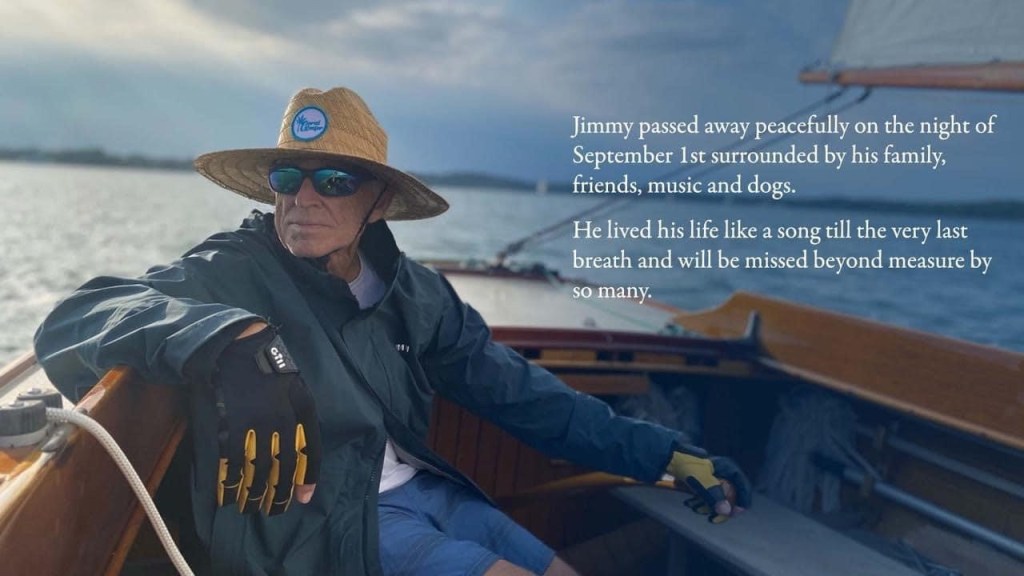
“Jimmy Buffett died!”
I had reconciled myself to the fact this news was coming at some point, but it saddened me nonetheless.
To be honest, I am not a card-carrying Parrothead. I have never been to a Jimmy Buffett concert, I don’t own a Hawaiian shirt, and I don’t particularly like margaritas. What I appreciated about Jimmy Buffett and his music was the joy, and the wisdom behind the words.
My relationship with Jimmy’s music began when I was a young Army lieutenant. At a unit cookout, my boss made a comment about having a “Cheeseburger in Paradise.” I looked into it, and I was hooked! From then on, when my Army career took me to less than desirable places, Jimmy and his music came with me. I recall running laps around Camp Able Sentry in Macedonia listening to “Barometer Soup,” and singing “Margaritaville” as I strolled through my command post in Kirkuk, Iraq (much to the dismay of my teammates.) Perhaps the pinnacle of my experience happened earlier this year—I was driving a Jeep up Mount Kilauea in Volcanoes National Park, with my family on board, when my daughter, who had put herself in charge of musical entertainment, added Jimmy’s “Volcano” to the playlist. It was a very proud moment!
With Jimmy’s music, it was not always about parties and beaches. More often than not, it was about surviving life’s hard knocks and coming out stronger and wiser. If you doubt that, have a listen to “Breathe In, Breathe Out, Move On,” which he wrote for New Orleans after Hurricane Katrina.
Jimmy Buffett was not everyone’s cup of tea. A friend referred to him as “the most successful one-hit-wonder in history.” As for me, Jimmy Buffet was a musical poet. He told truths, and he encouraged me to find joy in life. I am sad that Jimmy is gone, but we still have his music, and I will continue to heed his advice whenever I need him to remind me that “If we couldn’t laugh we would all go insane.”






 Compared to these other pandemics and epidemics, in 2020 we have many advantages. Science and medicine have come a long way: we are taking the measures necessary to slow the spread and expand capacity to treat those most severely affected. Critically, we see people coming together and finding ways to support one another. We are rising to the occasion, and we will endure.


 subject matter: conveying the nuances of a noble but long-gone culture seemed an insurmountable obstacle. The change recently seems to lie in my own understanding of this novel: it is less about the Haudenosaunee than it is about the inward journey of my protagonist, Gideon Hawke. In the course of this story Gideon learns a great deal about himself, and realizes he longs to be part of something greater than himself. He also struggles with the competing priorities in his life. The cultural backdrop is important, and I want to do it justice, but it is not worth hand-wringing.
 Robert Krenzel