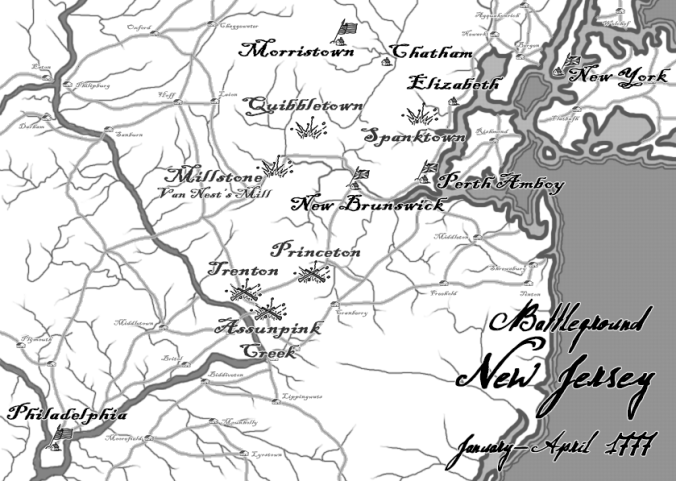
On February 23rd, 1777 the British and Americans fought one of the largest battles of the Forage War at Spanktown, near modern-day Rahway, NJ.
Increasingly frustrated by American attacks on their foraging parties, the British command unleashed Lieutenant Colonel Charles Mahwood, the aggressive British commander who very nearly won the day at Princeton. With four British infantry regiments, plus a battalion each of light infantry and grenadiers, Mahwood was well-equipped to challenge any American Continental or Militia units that stood in his way.
Happening upon a small American foraging party covered by a brigade of New Jersey Continentals on a nearby hilltop, Mahwood deployed his troops for battle. He launched a grenadier company on a wide flanking movement, preparatory to a massed bayonet assault. The British moved confidently, prepared to overcome American resistance with cold steel. Then the Americans sprang the trap.

Possible deployments at Spanktown, from A Nest of Hornets
The New Jersey units were bait. Hiding in ambush was a Pennsylvania Brigade including Colonel Edward Hand’s 1st Pennsylvania (formerly called both Thompson’s Rifle Battalion and the First Continental Regiment). The grenadier company unwittingly marched across the front of the hidden Pennsylvanians, who sprang from concealment and fired a volley which annihilated the flanking force. Both the New Jersey and Pennsylvania brigades now maneuvered aggressively against Mahwood’s remaining troops who, outnumbered and outflanked, fell back. The light infantry and grenadier battalions fought a brief rearguard action as the infantry regiments withdrew. Lieutenant Colonel Mahwood must be credited with escaping with most of his force intact, but the retreat soon turned into a route.
The British were not only driven from the field with significant losses, but the Americans pursued them all the way to the British stronghold in the Amboys. It must have been an agonizing defeat for the British hero of Princeton. More importantly, it foretold the successes of a Continental Army that, in eight months’ time, would bring General John Burgoyne to heel at Saratoga.
You can experience the Battle of Spanktown from a participant’s point of view in the novel A Nest of Hornets.
Robert Krenzel Author Facebook page: https://www.facebook.com/RobertKrenzelAuthor
Gideon Hawke Novels Facebook page: https://www.facebook.com/GideonHawkeNovels/


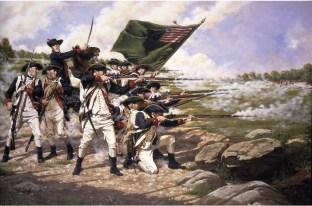
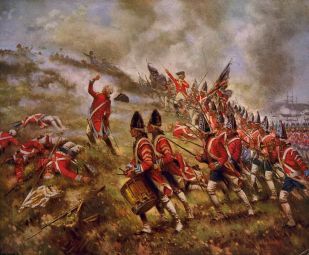 Having said all that, combat in North America was different from combat in Europe. In the Americas distances were greater, troops less numerous, the ground more broken, and cavalry less prevalent. These factors forced commanders on both sides to adapt their tactics: there is compelling evidence that units on both sides adopted open formations, with up to a yard between soldiers, and also employed double, rather than triple lines. These adaptations made formations less vulnerable to incoming fire and enabled them to cover more ground. At Bunker (Breed’s) Hill in 1775, for example, the British used tight formations and attempted to trade volleys with the American militia, who fought from behind breastworks. As a result they suffered staggering casualties. They also learned to rely on bayonet charges. Their third attack at Bunker Hill was carried out with bayonets only, and succeeded. The British took this lesson to heart.
 Robert Krenzel