January 1777; Chatham, NJ. I recently had the opportunity to interview Lieutenant Colonel Daniel “Black Dan” Scott of the New Jersey Militia, who appears in the novel A Nest of Hornets. Below you will find my questions and his answers. (NOTE: his answers were editing to remove profanity)
Robert Krenzel: Lieutenant Colonel Scott, please tell us a little about your background.
Dan Scott: Not much to tell, really. I was born in my family home in 1749. My father was a merchant; some of the ships that called at the Landing near our home came from across the globe, so I learned a fair bit about the world that way. I didn’t care much for school; I suppose you could say I was a bit of a trouble maker. I joined the militia when I was sixteen, and naturally for someone of my upbringing and talents I soon became an officer. When the war started I played quite a role in getting the Middlesex County Militia organized, so in 1775 I was raised to lieutenant colonel.
RK: You join us having already established a fierce reputation. How did you acquire the nickname “Black Dan?”
DS: [with a grin] It’s for my black hair.
RK: I’ve been told it has more to do with your actions than your appearance.
DS: You can’t believe everything you’re told. But…I suppose it’s a black day for him when a tory finds himself my prisoner.
RK: As I understand it, your troops don’t capture many Loyalists.
DS: Capture or bring into prison? There’s a difference. We’ve captured plenty. They just tend to die of their wounds or are killed trying to escape or some such thing. Whatever the cause, they just always seem to die. [Grinning] It’s a pity, that is.
RK: I see. So…you are married, are you not?
DS: Yes, of course! To my beloved Kate! We married in 1774, and she’s the best thing that ever happened to me!
RK: How did you meet?
DS: At a gala in New Brunswick. Our fathers arranged it, but for me it was love at first sight. We were married not long afterward. She is a fine, cultured woman with impeccable taste and good connections. We lived quite a happy life. Until the [multiple expletives] British came, that is.
RK: You used to reside in New Brunswick, but now you are in Chatham. Why is that?
DS: [turning red in the face] Because a [expletive] regiment of Hessian [expletives] is quartered in my [expletive] house right now! If I’d stayed there, the [expletives] would have hung me from the nearest tree and left me for the ravens. We had no choice but to leave. Fortunately our current residence was conveniently vacated.
RK: Your current home actually belongs to a Loyalist family, does it not?
DS: Yes. And I’m caring for it a lot better than my house is being looked after, I promise you that. Besides, I doubt they’ll be coming back for it.
RK: Have you heard from the current owners?
DS: No, and I don’t care to. May they rot in hell.
RK: The current war has been hard on New Jersey and its population; are you hopeful for the future?
DS: Oh, yes! Very much so! Some doubted our prospects, but I have never waivered in my belief in the Cause. Now, after Trenton and Princeton, it is fashionable to be optimistic, but I have always believed that we would come through this war stronger and more unified.
RK: What do you think it will take to heal the wounds left by this war?
DS: Two things: First, we beat the British and their craven, beef-witted, Hessian lackeys. Then, we hunt down every [expletive] Loyalist [expletive] who darkens this land with his filthy shadow: we hang each and every one from a tree and stretch his neck but good. Once that is done, everything else should sort itself out.
RK: Lieutenant Colonel Scott, thank you very much for your time. This has been truly…informative.
DS: Any time.
You can learn more about “Black Dan” Scott in Gideon Hawke #3, A Nest of Hornets!
A Nest of Hornets on Amazon: https://www.amazon.com/dp/B01NBI511Q/

 I knew the destination, so the next step was to identify the starting point. In poking around I discovered that Morgan’s headquarters was in the Hackensack, New Jersey area around the time Washington ordered Morgan to join the Northern Department. Having start and end points, I looked at the map and was hit with a blinding flash of the obvious: Hackensack and Albany both lay along the Hudson River. Given the primitive condition of the American road network in the 1770s, the fastest, cheapest, and easiest was to get five hundred men and assorted family members the roughly 130+ miles between these two points would have been to move straight up the Hudson.
 After months of researching, writing, rewriting, editing, rewriting some more, and even designing the cover, what was once an idea has become something tangible: a novel.
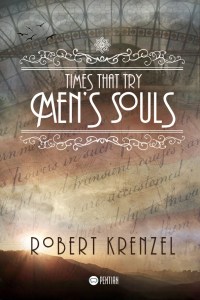 Act now to join in the success of my new novel, Times That Try Men’s Souls!
 Robert Krenzel