If you have read any of the Gideon Hawke novels, you may have noticed that I pay attention to the physical environment. Like many authors I make sure I take into the account the time of year and the weather, but I probably invest more than most in the position of the sun and the phases of the moon. Why? Because to me it matters.
As a soldier I found it critical to take into account the sun and the moon. Try attacking into the sun, or stumbling around the desert at night…until a rising full moon clears the mountains and switches the lights back on! Details that are of little note in our daily lives can be of critical import for a soldier on operations, and knowing how to use the environment to advantage can give that soldier a winning edge.
In Kosovo in 2000, the locals had an elaborate lookout system: when they saw Humvee headlights coming down the road (Humvees have very distinctive headlights) they would spread the word by short wave radio, or by signaling with their porch lights. This made it hard for conventional U.S. forces to do anything covertly. Hard, but not impossible. I found that with a decent amount of moonlight, we could operate our Humvees quite safely on the roads of my sector with our lights OFF. It was a personal moment of triumph when we drove right up to the house of a local Serb family, and the man of the house came out and said, “We didn’t know you were coming!” I smiled and replied, “I know!” We didn’t catch a lot of people in the midst of shenanigans that way, but we certainly kept some people on their toes!
In the 1770s, before photographic mapping, GPS, and night vision, knowing the environment was even more critical. Soldiers like Gideon Hawke, who had learned to move silently at night, take advantage of precious starlight and moonlight, and maximize the advantages of day and night, were at a tremendous advantage. Native American warriors, being raised to live with the land, tended to excel in these areas. This allowed them to move quickly and quietly, to seemingly appear out of nowhere, and to seemingly vanish just as quickly. There were “European” troops on both sides of the War for Independence who had learned these skills: whether they were called riflemen, rangers, jaegers, or something else, they used their skills to snoop and surveil, and sometimes to strike swiftly and without warning. Occasionally generals of the time would dust off this playbook: perhaps most famously, George Washington used the cover of night to conceal his approach marches, enabling the stunning victories at Trenton and Princeton.
I have never used the cover of night to give me the advantage in a pitched battle, but I have assembled troops in the night and launched operations at dawn. I have welcomed the descent of night, and breathed a sigh of relief at the coming of dawn. I have looked up into the celestial spectacle of a moonless Iraqi night, and said a prayer of thanks for the two “stars” flying a holding pattern overheard at 30,000 feet (They were Marine Corps F-18s flying in my support. Semper Fi!)

So, I suppose it is only natural that I make sure I take into account what the heavenly bodies are doing. Fortunately for me the U.S. Naval Observatory has a website that will tell you the solar and lunar data for a particular place and time, even back to the 1700s! So, if I happen to mention that Gideon assembles his men at Valley Forge in the pre-dawn hours of April 23rd, 1778, just as a crescent moon rises, or that there was a total solar eclipse a few days before the Battle of Monmouth, you can be fairly certain that I didn’t make that up. I use my imagination to fill in a lot of details in the Gideon Hawke novels, but I will never trifle with the sun and the moon.
U.S. Naval Observatory Sun and Moon Data for One Day: http://aa.usno.navy.mil/data/docs/RS_OneDay.php
Robert Krenzel Facebook Author Page: https://www.facebook.com/RobertKrenzelAuthor/
Gideon Hawke Novels Facebook Page: https://m.facebook.com/GideonHawkeNovels/


 For Gideon’s author, however, his turning eighteen creates an emotional dilemma: changing genres! While I willfully ignored this milestone in the publishing process for A Constant Thunder (he was seventeen at the start of the novel), Gideon Hawke #5 is forcing me to look fact squarely in the eye: I am no longer a young adult author. You see, I always considered myself a YOUNG ADULT historical fiction author. Gideon was fifteen when we met him, after all. This worked out nicely because my kids were in the same age band: they were in the target audience. They, however, have grown older, as has Gideon. As my son fights his way through college scholarship applications, eighteen year-old Gideon shivers with his men at Valley Forge, and I struggle with the idea of being a “New Adult” historical fiction author.

 That bears some explanation. The popular mythology of Valley Forge is well-established: a ragged, beaten Continental Army staggers into Valley Forge after losing another campaign, and huddles together, waiting for deliverance. A few months later it rises from the ashes of its campfires, retrained and revitalized, ready to take on the British. But is that correct? Probably not.
 That was all very interesting, but the moment that stayed with me occurred just as we were stepping out of the exhibit. A young lady, an employee of the museum, probably in her twenties, stopped me as I was leaving to comment on my scarf. You see, as it was cold and windy outside, I was carrying not only my coat, but also a shemagh (also known as a keffiyeh): a red and white Arab headscarf. The young lady commented on the beauty of my scarf; at a glance she observed that it looked as though it had been handmade in Iraq. I was a bit taken aback: my interpreter had bought it at the local market for me during my deployment to Kirkuk. For me it was a token of our friendship and a reminder of one of the noblest things I have done in my life, as well as a toasty warm scarf! The young lady continued to explain not only how she was able to identify its origins, but also how it differed from the ones produced in her homeland of Palestine.
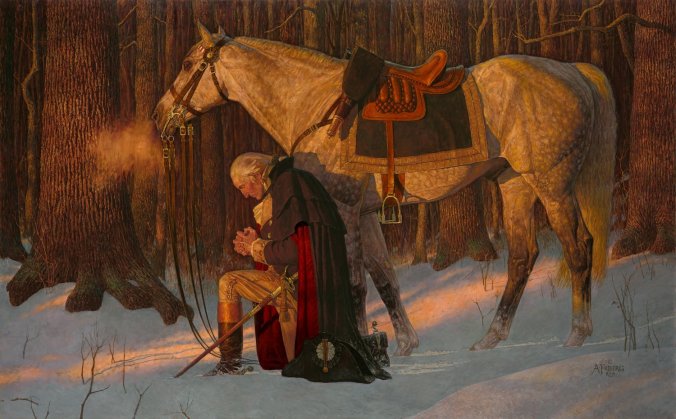

 Thank you everyone who purchased Gideon Hawke books this month! This was a strong month for sales, and as a result today I am donating $25.00 to Invisible Wound in honor of Veteran’s Day and the Centennial of the first Americans entering combat in World War I.
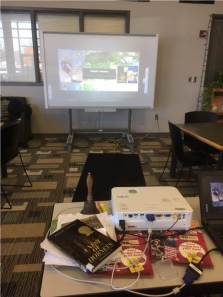 Yesterday I had the opportunity to discuss the Gideon Hawke Series with the 8th Grade and Mill Creek Middle School in Lenexa, Kansas.


 Robert Krenzel