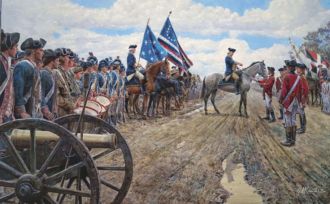
Where Armies Go, the Pox Follows: Smallpox in the American Revolution

The Number 1 killer of soldiers and civilians during the American Revolution was smallpox.

Now that this disease has been eradicated the name “Smallpox” no longer invokes the terror it once did. During the American Revolution however, 90% of deaths in the Continental Army were due to disease, and the two strains of Variola smallpox virus were the most brutal of these afflictions. Smallpox was also the target of the first military inoculation campaign in history.

Smallpox is a highly contagious disease characterized first by a rash and then by raised, fluid-filled blisters over the entire body. The mortality rate could be up to 35%. Over 60% of survivors suffered from scarring, and some might experience blindness, arthritis, or even limb deformation. This disease plagued humanity since at least the time of Ancient Egypt, and by the 1700s it was killing hundreds of thousands of Europeans annually. Having had no prior exposure to the disease, and thus no immunity, smallpox devastated Native American tribes when Europeans infected them (sometimes deliberately).

During the Siege of Boston in 1775-1776 a smallpox outbreak struck the British garrison in Boston, and threatened to cross the siege lines to infect the American forces. Because of its prevalence in Europe and relative scarcity in the Americas, the British troop population, was less susceptible to the disease than the Americans. A significant percentage of British troops had either survived the disease or been inoculated (exposed to a less deadly strain), and were thus immune. Far fewer colonists had any prior exposure to smallpox, thus they were highly susceptible to infection. The Continental Army was lucky outside Boston, but the pox made its full fury felt among the American troops sent to invade Quebec in 1775. During the Siege of Quebec the British intentionally released numerous sick Canadian civilians, who subsequently infected the besieging Americans. This outbreak seriously weakened the attackers, contributing to the expedition’s ultimate failure. It also served as a loud and clear warning to the Commander-in-Chief, General George Washington.

During a trip to Barbados as a young man, Washington had contracted and survived smallpox, so he was keenly aware of the disease’s effects. He was also aware of the risks of inoculation: not only would inoculated troops be sickened, but some would die. There was also the potential that inoculated troops could actually spread the disease, causing an outbreak. Fear of inoculation was so great that in 1776 the Continental Congress forbade military surgeons from so treating the troops, but in February of 1777 Washington made the momentous decision to inoculate the 75% of the Continental Army who had not previously been exposed to the disease. Currently serving troops would receive the jab, as would new recruits, who would not join their units until healthy and immune. All of this was done in the greatest secrecy; had the British discovered that large numbers of American troops were sick due to inoculation, they might have attacked, dealing Washington’s Army a fatal blow.

In spite of the risks, Washington’s inoculation program, the first in military history, was a complete success. Subsequent to 1777, at no point were the British able to benefit from the ravages of smallpox in American units. In fact, the few smallpox outbreaks that did occur were very localized, and had minimal impact on Continental Army operations. The British and their Hessian allies were not defeated until 1781, but by combining cutting edge medical technology with a daring command decision, Washington won a decisive victory over smallpox in 1777.

Gideon Hawke and Ruth Munroe will witness firsthand the ravages of smallpox in the forthcoming Gideon Hawke #4: A Constant Thunder.

Library of Congress article on George Washington and Smallpox inoculation: https://www.loc.gov/rr/scitech/GW&smallpoxinoculation.html

Mount Vernon article on Smallpox, including an informative video: http://www.mountvernon.org/digital-encyclopedia/article/smallpox/

Robert Krenzel Author Facebook page: https://www.facebook.com/RobertKrenzelAuthor

Gideon Hawke Novels Facebook page: https://www.facebook.com/GideonHawkeNovels/

The Forage War: Spanktown

On February 23rd, 1777 the British and Americans fought one of the largest battles of the Forage War at Spanktown, near modern-day Rahway, NJ.

Increasingly frustrated by American attacks on their foraging parties, the British command unleashed Lieutenant Colonel Charles Mahwood, the aggressive British commander who very nearly won the day at Princeton. With four British infantry regiments, plus a battalion each of light infantry and grenadiers, Mahwood was well-equipped to challenge any American Continental or Militia units that stood in his way.

Happening upon a small American foraging party covered by a brigade of New Jersey Continentals on a nearby hilltop, Mahwood deployed his troops for battle. He launched a grenadier company on a wide flanking movement, preparatory to a massed bayonet assault. The British moved confidently, prepared to overcome American resistance with cold steel. Then the Americans sprang the trap.

spanktown

Possible deployments at Spanktown, from A Nest of Hornets

The New Jersey units were bait. Hiding in ambush was a Pennsylvania Brigade including Colonel Edward Hand’s 1st Pennsylvania (formerly called both Thompson’s Rifle Battalion and the First Continental Regiment). The grenadier company unwittingly marched across the front of the hidden Pennsylvanians, who sprang from concealment and fired a volley which annihilated the flanking force. Both the New Jersey and Pennsylvania brigades now maneuvered aggressively against Mahwood’s remaining troops who, outnumbered and outflanked, fell back. The light infantry and grenadier battalions fought a brief rearguard action as the infantry regiments withdrew. Lieutenant Colonel Mahwood must be credited with escaping with most of his force intact, but the retreat soon turned into a route.


The British were not only driven from the field with significant losses, but the Americans pursued them all the way to the British stronghold in the Amboys. It must have been an agonizing defeat for the British hero of Princeton. More importantly, it foretold the successes of a Continental Army that, in eight months’ time, would bring General John Burgoyne to heel at Saratoga.

You can experience the Battle of Spanktown from a participant’s point of view in the novel A Nest of Hornets.

Robert Krenzel Author Facebook page: https://www.facebook.com/RobertKrenzelAuthor

Gideon Hawke Novels Facebook page: https://www.facebook.com/GideonHawkeNovels/

Revolutionary Strategy: The Hudson River

The Saratoga Campaign was a disaster for the British. It was such a resounding success for their American adversaries that it overshadowed the British occupation of Philadelphia in persuading France to enter the war on the American side. With the benefit of hindsight, one might wonder what brought a British Army to a remote stretch of woods north of Albany, where it would be forced to march into captivity. Well, simply put, the Saratoga Campaign may have been the closest the British came to a winning military strategy.

albanyIn the 1700s there was no highway system in the United States, and all-season roads were a rarity. The fastest and most efficient way to move people and goods was often by water. Commerce flowed up and down rivers, and ferries traversed the larger rivers to connect what road networks existed on either side. The British rightly considered the New England states to be the birthplace of the Revolution, and the theory was that if they could isolate New England from the rest of the rebellious former colonies, they might be able to concentrate their forces and stamp out the rebellion piecemeal. At the very least, establishing a cordon around New England might have forced George Washington into attacking to break the cordon. Given superior British discipline, firepower, and potentially numbers, such a battle might well have led to the destruction of Washington’s main force; in that event American capitulation would likely have been merely a matter of time.

Given those considerations, when viewing a map from across the Atlantic, the Lake Champlain-Lake George-Hudson River Corridor looked like an inviting invasion route. It had in fact historically been the quickest route for travel between Canada and New York. It seemed reasonable that an army of several thousand people should be able to attack southward down the corridor and link up at Albany with a force coming northward from New York. This would put in British hands the key ferries across the Hudson and open up communications between New York and Canada. New England would be isolated from the rest of the states, and George Washington would be between the proverbial rock and hard place.

Fortunately for the Americans, what looked easy from London was much harder in practice. The British could move supplies and troops by water, but they could not simply sail all the way to Albany. They had to fight their way overland to clear American troops from the river’s banks. The American’s however, pursued a Fabian strategy of falling back in the face of superior numbers, destroying bridges, felling trees across roads, and even inundating roadways as they went. They also proved adept at slipping around the main British force and attacking British lines of communication. Plagued by poor roads, too few wagons and draft animals, and rebel interdiction, Burgoyne found that every time he advanced a few miles, he had to pause for weeks to amass supplies. All the while, more and more American forces were massing between him and his objective of Albany.

Hudson emplacement

The Great Redoubt at the Saratoga Battlefield, overlooking the Hudson River.

In spite of all that, the British Hudson Campaign might still have succeeded, but the nail in the coffin for the British strategy was poor strategic management. Lord Germain, the British Secretary of State for America, was a notorious micromanager, attempting to dictate military strategy from across the Atlantic via letters that took weeks if not months to reach their recipients. In the case of overall strategy for 1777 however, Germain committed the cardinal strategic sin of not setting a unified strategy for the North American theater. He directed Burgoyne to reach Albany and then operate under command of General Howe, the British land force commander for North America, but Germain failed to direct Howe to attack up the Hudson to link up with Burgoyne. Howe pursued his own strategy of capturing Philadelphia, leaving only a defensive force, with restrictive guidance, in New York. This force, under Clinton, did attack up the Hudson, but was not powerful enough to get through to Albany and then fight through the forces opposing Burgoyne. So, ultimately, Burgoyne’s hopes of breaking through were dashed at Bemis Heights.

The British would never again come so close to restoring Crown rule in their erstwhile colonies.

Robert Krenzel Author Facebook page: https://www.facebook.com/RobertKrenzelAuthor

Gideon Hawke Novels Facebook page: https://www.facebook.com/GideonHawkeNovels/

Clash of Cultures: The Wilderness War

Up to this point in the Gideon Hawke Series I have explored the fighting between Americans and British, Americans and Germans, and Patriots and Loyalists. I have even delved into the seedy underworld of espionage. Now, as I work on Gideon Hawke #4, A Constant Thunder, I have for the first time crossed the threshold into cross-cultural warfare: Americans versus Native Americans.


natarcbrant280pix

Joseph Brant (Thayendanegea): Mohawk leader

When British General John Burgoyne launched his campaign from Canada down the Hudson, a wave of Native Americans moved in advance of his army. While Burgoyne made some efforts to put constraints on these warriors, his limitations ran contrary to the fundamental reasons why Native Americans went to war, because the Native American concept of warfare was very different from the European model. Operating in small bands under a “democratically” recognized leader, these men joined the campaign both for profit and to prove their worth as warriors. They valued individual valor, and unit discipline was an alien concept. Furthermore, many aspects of their culture, such as the taking of scalps, or the abduction or torture of captives, were abhorrent to Americans, as was their tendency to appear out of the wilds and descend upon isolated families or towns. That said, from our distant perspective it is easy to see that many tribes could in many ways be considered “progressive;” while they might be intolerant of outsiders, among their own people they were remarkably tolerant, and women had a prominent role in governance and strategy. Their brutality in warfare and the underlying values of Native American culture were so alien to the culture of transplanted Europeans that their motivations were rarely understood except in the context of their being considered “savages.”


This explains why the specter of Native American attack spread panic across the northern States, but also galvanized resistance to Burgoyne’s invasion. As a result, substantial militia and Continental forces moved to reinforce the American forces in the Hudson Valley. One of the units which marched north to challenge Burgoyne and his Indians, and had a tremendous impact on the outcome of the campaign, was Morgan’s Rifle Corps.

One of the Rifle Corp’s first tasks when it arrived in the Albany area was to take to the wilds of the Hudson Valley and defeat the bands of Native Americans and Loyalists who still dominated “No Man’s Land.” At that point, in the wake of the American successes at the Battle of Bennington and Oriskany (the latter arguably an American defeat, but one which caused heavy losses to the tribesmen), Native Americans were beginning to abandon Burgoyne, but were still very active. Thus the Rifle Corps soon found itself in numerous small but vicious encounters with Native Americans; this was a clash of cultures as much as a clash of arms. Many if not most of Morgan’s men had experience in Native American warfare, so they knew what they were getting into. They knew that their foe was at home in this strange, wild environment, and that the fighting would be bitter, close, and to the death.

As I write A Constant Thunder, this is the type of warfare in which Gideon Hawke has found himself. It will challenge his sense of right and wrong. It will test his endurance. It will force him to compromise on his ideals. He will have to quickly learn the ways of his enemies and beat them at their own game. If he succeeds it will be quite an accomplishment, but it will only be a preamble. Death, and an alien world, may lurk in the woods, but destiny awaits at Freeman’s Farm and Bemis Heights.

Robert Krenzel Author Facebook page: https://www.facebook.com/RobertKrenzelAuthor

Gideon Hawke Novels Facebook page: https://www.facebook.com/GideonHawkeNovels/

For Want of a Nail: Did Bad British Logistics Lose America for the Crown?

It is a cliché in the military that amateurs talk about tactics and professionals talk about logistics, but behind many clichés lay hard truths. While there are several reasons the British lost the American War of Independence, poor logistics may have doomed them from the start.

In some respects the British war in the Americas was a masterpiece of strategic logistics. Within 15 months of “The Shot Heard ‘Round the World” the British Empire had assembled the largest land and naval expeditionary force in history and projected it across the Atlantic Ocean. But at the local level, that force quickly ran into trouble.

First and foremost, British military logistics were not centralized. The British Treasury Department was responsible for supplying food and forage. The Navy Board was responsible for oceanic transportation, and the Ordnance Board has responsibility for supplying artillery and munitions. The position of Quartermaster General had responsibility for logistics oversight for the Army, but also served as a Chief of Staff, so his focus was not entirely on logistical problems. To make matters worse, the Army’s Commissary Department was notoriously corrupt. In this time period it was expected that Army Commissaries, who were civilians, would profit from their service; in fact it was not uncommon, perhaps even expected, that people would fleece the government whenever possible. Efforts by suppliers to cut corners, compounded by official corruption, combined with a harsh trans-Atlantic voyage, meant that much if not most of the food shipped to the Americas from Great Britain was lost or spoiled en route. This forced the British Army in North America to forage.

Once the British cleared American forces from Long Island and Manhattan and penetrated the rich farmlands of New Jersey, it was hoped that the bounty from New Jersey and occupied New York would solve British food supply problems. Washington’s daring raid on Trenton proved the folly of dispersing garrisons across New Jersey, and the newly-emboldened Jersey Militia and Continental Army made life nearly unbearable for the British and their Hessian allies. Foraging expeditions turned into running battles, and the British were forced to commit larger and larger forces to efforts to simply seize stock of flour. To make matters worse, depredations committed by British and Hessian troops while foraging provided excellent fodder for American propaganda, and convinced many Americans to get off the fence and support the patriot cause.

The scarcity of supplies of all kind, and the primitive conditions prevalent in North America, forced General John Burgoyne into one of the greatest British disasters of the war: his surrender at Saratoga. In his plan to attack out of Canada and down the Hudson Valley, Burgoyne had envisioned enlisting thousands of horses and wagons which simply never materialized. His campaign of 1777 was marked by fits and starts: he would surge forward and win a tactical victory, and then halt for weeks to lick his wounds and gather supplies while his American foes gathered forces, destroyed roads, and prepared defenses. Burgoyne lost 10% of his force in the Battle of Bennington, which was essentially a foraging expedition gone disastrously wrong. By the time he drew near to objective at Albany, his force was weakened and depleted, and he was faced with a very strong American position manned by patriots who knew their foe was on the ropes. After his surrender at Saratoga his men marched into captivity in tattered clothes, while the French court was convinced it was time to join the American cause.

Arguably the only way the British could have won the war was by cutting loose from their logistics base and pursuing Washington’s Army in a war of maneuver and forcing it into a decisive battle. In this case the superior British training, discipline, and firepower might have won the day, but the British Army was simply not equipped to sustain itself away from rivers and ports. Such a daring move risked the British main force itself being isolated and withering on the vine, just as Burgoyne’s force had done.

surrenderIn the final act of the War, General Cornwallis dashed across Virginia in an example of what a British force could accomplish if it cut loose from its logistical tail. Unfortunately for Cornwallis, the French Navy for once achieved local superiority over the Royal Navy, and Cornwallis found himself with his back to the York River. He was forced to slaughter his horses to preserve his very limited stocks of food, and his troops were weakened by the effects of malaria. With no relief in sight, a dwindling force, and a growing American-French force pounding his defenses, Cornwallis was forced to surrender, and the Crown was forced to the negotiating table.

The British Army in the Americas suffered from numerous challenges during the American Revolution. But throughout the war, from the generals unable to pursue a winning strategy to the privates with grumbling stomachs, logistical problems would be a constant reminder of the challenges of fighting an implacable foe far, far from home.

You can learn more about the fight for American Independence in the Gideon Hawke Series.

Robert Krenzel Author Facebook page: https://www.facebook.com/RobertKrenzelAuthor

Gideon Hawke Novels Facebook page: https://www.facebook.com/GideonHawkeNovels/

This Lady Has Lost Her Way

A short story, or “Drabble” I wrote last week. I hope you enjoy it!

The Drabble's avatar

eye-1255968_1920

By Robert Krenzel

This Lady has lost her way.

She is an immigrant: a French girl, originally.

She welcomed others, lighting the way to a better life.

She watched, twice, with pride as the boys sailed off to rescue her homeland. She counted them back; too many never returned.

She wept as she watched the towers burn and fall. They were immigrants, like her. How could they?

She grew angry and suspicious.

Lately she has lost her way. The light has gone dark. She no longer welcomes the wretched refuse.

Only for a time. Maybe just for a few years. Maybe just four.

     
Bio:
Bob Krenzel writes historical fiction in his spare time. A 24-year Army veteran, he served in the Balkans, Iraq, and Afghanistan.

View original post

Character Interview: Kate Scott

January 1777; Chatham, NJ. After my interview with Lieutenant Colonel Daniel Scott of the New Jersey Militia, I had the opportunity to speak with his wife, Kate, who also appears in the novel A Nest of Hornets. Here are my questions and her responses:

Robert Krenzel: Mrs. Scott, please tell us a little about your background.

Kate Scott: Please, Dear, call me Kate. What should I say? I am from New York City. I was born there in 1753, as Katherine Vogels. I was quite happy there until my family moved to that little backwater in New Jersey called New Brunswick. I made the best of it, I suppose, but there was so little for an ambitious young girl to do! Fortunately we were not so far as to preclude occasional visits to New York for culture and shopping.

RK: You are not happy here in New Jersey?

KS: I am happiest where there is society and culture. Frankly, I would prefer London or Paris, but if we must be on this Continent, I would prefer New York; or perhaps Boston or Philadelphia. And while New Brunswick was bad, this place we are in now is just beastly! We might as well all be wearing animal skins and dancing around a fire.

RK: As you implied you currently reside in Chatham, but used to be in New Brunswick. As I understand it from your husband enemy troops are now quartered in your New Brunswick estate, and you all fled for your lives. Can you tell me more about that?

KS: Fortunes of war, I suppose. I would certainly not say I fled for my life, though. I think Daniel would have preferred to fight to the death in our front door; I don’t know how well it would have gone for me under those circumstances, so I persuaded him to remove us somewhere away from the fighting. In retrospect, perhaps I should have let him fight it out.

RK: Your husband indicated you have a happy marriage. You must feel very fortunate.

KS: [with raised eyebrows] Oh, of course. What lady would not consider herself blessed to be married to such a man?

RK: He is something of a hero, is he not?

KS: I suppose so. He is certainly committed to his cause.

RK: He has a reputation for ferocity; is there a hidden side of him at home that his troops would be surprised to see?

KS: [smiling enigmatically] At home he is like a puppy in my lap.

RK: How did you meet?

KS: My father arranged it. Daniel came from a well-to-do family with reasonable connections. It was a good match.

RK: You recently had a chance to meet a young Continental officer named Lieutenant Gideon Hawke, who is of interest to my readers. What can you tell us about him?

KS: He is such a delightful young man! He is very eager to please, which I like in men, and very handsome. He seems a bit naïve in social settings, but I have no doubt he is a fearsome on the battlefield as his reputation would suggest.

RK: Have you noted any tension between him and your husband?

KS: There is tension between everyone and my husband. I think dear Gideon is very idealistic. My husband is more pragmatic. I can see how that would lead to the occasional difference of opinion, don’t you?

RK: Quite; especially in a time like this when politics and war have torn families apart. Having been through so much, what words of wisdom would you offer to young ladies in these trying times?

KS: The same advice I offer all young ladies: “Marry a handsome man and you marry trouble.” Those are words to live by.

RK: Yes…well…I was referring to the war. Are you saying that in spite of the war everything revolves around marriage?

KS: What I am saying…and please don’t take me for a hopeless romantic…is that I am a practical woman. I would say that whom she marries is very important for determining how comfortable a young lady will be, and how many options she will have available, especially in times such as these.

RK: I see. The current war has been hard on New Jersey and its population; are you hopeful for the future?

KS: I am absolutely certain I will find a way to manage.

RK: What do you think it will take to heal the wounds left by this war?

KS: I suppose each person will have to find her own way. I will certainly find mine.

RK: Do you think America will win its independence?

KS: I have no idea. The war is not a particular concern of mine, aside from how it affects me directly. I can’t say I care one way or another about the cause.

RK: Kate, thank you very much for your time. This has been truly…informative.

KS: [Placing a hand on my arm] It has been delightful!

You can learn more about Kate Scott in Gideon Hawke #3, A Nest of Hornets!

A Nest of Hornets on Amazon: https://www.amazon.com/dp/B01NBI511Q/

Character Interview: Lieutenant Colonel “Black Dan” Scott

January 1777; Chatham, NJ. I recently had the opportunity to interview Lieutenant Colonel Daniel “Black Dan” Scott of the New Jersey Militia, who appears in the novel A Nest of Hornets. Below you will find my questions and his answers. (NOTE: his answers were editing to remove profanity)

Robert Krenzel: Lieutenant Colonel Scott, please tell us a little about your background.

Dan Scott: Not much to tell, really. I was born in my family home in 1749. My father was a merchant; some of the ships that called at the Landing near our home came from across the globe, so I learned a fair bit about the world that way. I didn’t care much for school; I suppose you could say I was a bit of a trouble maker. I joined the militia when I was sixteen, and naturally for someone of my upbringing and talents I soon became an officer. When the war started I played quite a role in getting the Middlesex County Militia organized, so in 1775 I was raised to lieutenant colonel.

RK: You join us having already established a fierce reputation. How did you acquire the nickname “Black Dan?”

DS: [with a grin] It’s for my black hair.

RK: I’ve been told it has more to do with your actions than your appearance.

DS: You can’t believe everything you’re told. But…I suppose it’s a black day for him when a tory finds himself my prisoner.

RK: As I understand it, your troops don’t capture many Loyalists.

DS: Capture or bring into prison? There’s a difference. We’ve captured plenty. They just tend to die of their wounds or are killed trying to escape or some such thing. Whatever the cause, they just always seem to die. [Grinning] It’s a pity, that is.

RK: I see. So…you are married, are you not?

DS: Yes, of course! To my beloved Kate! We married in 1774, and she’s the best thing that ever happened to me!

RK: How did you meet?

DS: At a gala in New Brunswick. Our fathers arranged it, but for me it was love at first sight. We were married not long afterward. She is a fine, cultured woman with impeccable taste and good connections. We lived quite a happy life. Until the [multiple expletives] British came, that is.

RK: You used to reside in New Brunswick, but now you are in Chatham. Why is that?

DS: [turning red in the face] Because a [expletive] regiment of Hessian [expletives] is quartered in my [expletive] house right now! If I’d stayed there, the [expletives] would have hung me from the nearest tree and left me for the ravens. We had no choice but to leave. Fortunately our current residence was conveniently vacated.

RK: Your current home actually belongs to a Loyalist family, does it not?

DS: Yes. And I’m caring for it a lot better than my house is being looked after, I promise you that. Besides, I doubt they’ll be coming back for it.

RK: Have you heard from the current owners?

DS: No, and I don’t care to. May they rot in hell.

RK: The current war has been hard on New Jersey and its population; are you hopeful for the future?

DS: Oh, yes! Very much so! Some doubted our prospects, but I have never waivered in my belief in the Cause. Now, after Trenton and Princeton, it is fashionable to be optimistic, but I have always believed that we would come through this war stronger and more unified.

RK: What do you think it will take to heal the wounds left by this war?

DS: Two things: First, we beat the British and their craven, beef-witted, Hessian lackeys. Then, we hunt down every [expletive] Loyalist [expletive] who darkens this land with his filthy shadow: we hang each and every one from a tree and stretch his neck but good. Once that is done, everything else should sort itself out.

RK: Lieutenant Colonel Scott, thank you very much for your time. This has been truly…informative.

DS: Any time.

You can learn more about “Black Dan” Scott in Gideon Hawke #3, A Nest of Hornets!

A Nest of Hornets on Amazon: https://www.amazon.com/dp/B01NBI511Q/

Short Story: A BARREN COUNTRYSIDE (Springfield, NJ; January 6th, 1777)

Is that a ghost? The thing seemed to be both dead and alive at the same time. Under normal circumstances neither word would apply to a small stone farmhouse, but here and now, they seemed most appropriate. The building looked dead because its charred interior, greyish walls, and the gaping windows and doors made it look alarmingly like a human skull. It looked alive because the two windows, the eye sockets, seemed to stare menacingly at passersby; especially passersby with guilty consciences.

Should we feel guilty? The captain wondered as he stared back at the house. Certainly his men had not set this particular house aflame, but how many others had they burned as they pursued the retreating rebel army? There had been many houses like this, each one home to a family, and each family had protested their innocence. None of them, they claimed, were sympathetic to the rebellion. Not that it had mattered. His men, along with so many others, had driven the families out, taken what valuables they could carry, rounded up the livestock, and laughed as the flames destroyed the families’ hopes and dreams.

There had been so much screaming and crying! Many of these Americans had gone too far in their protests, and earned themselves a smash from a musket butt or a thrust from a bayonet. It was harsh. It was terrible. But it was war. Now these Americans had learned the awful price of rising up against their God-given King: slaughter and desolation are the fruits of rebellion.

The captain shuddered against the wind. The dark gray sky and bare trees mirrored his bleak mood. It’s not the bone-chilling cold that’s so bad, he thought, nor is it the mind-numbing weariness. It’s not the fierce hunger pangs. Nor is it the fear of sudden death, or the pervading sense of doom. It’s all of those things combined! That’s what I hate about this miserable country!

The journey from their home in the principality of Waldeck last summer had been a nightmare; the captain had never sailed on the ocean before, and he had really thought the constant sea sickness would kill him. It had taken him and his men weeks to recover their strength in the stifling heat and humidity of Staten Island.

But once they actually started fighting the American scoundrels it had seem this war would turn into something of a lark; every time they grappled with the rebels, the discipline of the sturdy German troops had won the day, and the foe had fled the field. They had chased the Americans off of Long Island, off of Manhattan Island, and into the Jerseys. Here in New Jersey they were finally able to treat the population the way they deserved: brutally. In their wake the armies left almost nothing to sustain the rebellious population through this harsh winter.

Unfortunately, that same devastation was now the biggest problem facing the British command. The plan had been to disperse the armies across the province and leave responsibility for foraging to the local garrison commanders. That would have been so simple! The captain wondered, Who could have foreseen this? Washington’s Army had seemed on the verge of collapse! How had that old fox managed to scrape together enough troops to go on the offensive? In less than two weeks he had crossed the Delaware, captured the Hessian garrison at Trenton, given the British the slip, returned to Trenton, humbugged his British pursuers, and shattered the British garrison at Princeton. Now it seemed that the Allied generals had panicked, pulling all of the British and German garrisons back into a small area in New York and Northern New Jersey.

Unfortunately, the men were now packed so tightly they couldn’t sustain themselves, and because the armies had done such a fine job devastating the New Jersey countryside that they were now having a devil of a time finding enough supplies to survive the winter.

As if the lack of provender were not enough, the Jersey militia had been delighted to see the British and Germans on the run; they been active in November and December, but the news of Trenton and Princeton had made them astonishingly bold! The lack of lodging meant his men had to sleep on the bare ground, and that was uncomfortable, but because of the constant alarms they had to do so fully clothed every night, with their weapons close at hand, ready to turn out at a moment’s notice in the event of militia attack. The men were subsisting on little but salted pork. That was depressing but manageable. The horses, unfortunately, needed fodder, and that had to be acquired from the nearly barren local countryside. That was why they were on the march today.

The captain and his fifty men, plus a dozen British light dragoons, were marching to chase away any militia and seize anything that might serve as horse fodder. With any luck they might catch a local farmer unawares and snatch a bit of fresh meat on the hoof; that would be a wonderful bonus!

The captain’s thoughts returned to the melancholy farmhouse. We are certainly not going to get anything from this farm. Where once animals had grazed and a family had eked out its living, now nothing stirred except a bit of snow drifting in the winter wind. All the while the farmhouse maintained its vengeful gaze.

tree-in-winter

The captain tore his eyes away from the building and looked ahead, toward the troop of dragoons about a quarter mile in front of his infantry. The road here crossed open fields, the stubble of a crop poking through the frost and snow marking what was once cultivated land. The fields were hemmed in on each side by gray, desolate woods. A low stone wall no more than waist-high bounded the field to the front of the horsemen. Beyond the fence was more barren forest.

POP! The captain sat upright on his horse. POP! POP! Musketry! The dragoons wheeled about in the field as puffs of smoke appeared along the wall in front of them. A few of the horse troopers fired from the saddle. What’s happening up there?

The captain spurred his horse forward and before long was up among the dragoons. Their lieutenant asked for permission to retire. Very well. Your task here is done for now. Soon the horsemen were dropping back, and the enemy fire faded away. The captain was now alone in the middle of the field. To his front, near the road, he could see about a dozen American militiamen in civilian clothes skulking behind the stone wall. From about a hundred yards away the rabble seemed immensely pleased with themselves for having driven off the horsemen. The enemy seemed to have no intention of retiring; they must not have seen the infantry yet. Excellent! The men will relish the chance to give this rebel scum the bayonet!

As the dragoons trotted rearward the infantry company deployed into a double line, in open order. The men moved smartly. The captain waited patiently, immobile, while the lieutenants and sergeants kept the men moving forward. They marched steadily, in cadenced step, closing the distance to the rebels. As the company neared the captain urged his horse forward, leading the men on toward the fight.

Once again shots rang out from the fence, and a few balls whistled by harmlessly. The rebels still showed no sign of running. Good! This will be over quickly!

The rebels worked feverishly to reload their muskets and fire at the advancing Waldeckers. The captain was not sure whether to admire or pity such foolish courage. At about seventy-five yards the captain halted his men, dressed their line, and ordered them to fix bayonets. That done, the relentless advance continued. This is too easy! The men might not even have to dirty their muskets by firing! A glance over his shoulder confirmed the dragoons were following behind the infantry, ready to take up the pursuit when the rebels broke and ran. Everything is in place!

The captain was gauging the distance. They were getting very close, almost within fifty yards. The militia had stopped firing; a few finished reloading their muskets. They were so close he could make out the smug, confident look on the enemy’s faces. They were clearly not afraid. What is that about? Why aren’t they frightened? Are they drunk? Don’t they realize we outnumber them almost five-to-one? Or do they know something I don’t?

Just then one of the twelve Americans let out a shout. Almost as one, about a hundred American militiamen rose from behind the stone wall. The captain froze, his mouth agape. It seemed to him that time slowed to a crawl. In perfect unison the rebels made ready and leveled their muskets. Then a wave of flame and smoke erupted from their line, and dozens of lead balls smashed their way through the company.

The first volley snapped the Waldeckers into action. The officers and sergeants started barking orders. Miraculously none of the leaders were down, but several of the men were sprawled on the ground or staggering rearward. As they had trained to do so often, and had done in earnest on several occasions, sergeants yelled and shoved to get the men to quickly close the gaps in the line. In no time the company was trading volleys with the militia. His men were much faster at loading and firing, but were hindered by the bayonets fixed to their muzzles. They were also fully exposed. In contrast the militia had the advantages of numbers and the stone wall. The wall would make the difference; over time more rebels than Waldeckers would survive the exchange. It was simply a matter of mathematics. A quick glance at his line told the captain that his company was in mortal danger. He has led them right into a trap, but perhaps a bayonet charge would save the day. Perhaps, just perhaps, one quick rush would break the Americans or at least buy him time to…ZIP—THUD!

The captain felt as though he had been punched in the gut. I’ve been shot! He felt the wound and then stared at the blood on his gloved hand. One of the lieutenants rode up and asked if he was badly hurt. Should I hand over command? Another ZIP was followed by a CRACK, and the lieutenant fell from his horse with a gaping hole in the side of his head. Something caught the captain’s eye, and he looked up at the forest off to the right flank of his company. There, about a hundred yards away, a puff of smoke! ZIP—THUD! Another bullet slammed into the captain’s thigh. Rifles! He hadn’t considered that. The captain took a last glimpse at what was left of his company. Half of the sergeants had fallen, and the hidden riflemen were singling out the rest. Nearly leaderless, the men who could still do so started running for their lives. Good, maybe some of them will escape. As his command disintegrated, the captain slid off his horse and fell in a heap on the iron hard ground. That should have hurt, but I hardly felt it! I must be in a bad way.

The captain was distracted by figures rushing by. He struggled to make sense of what he was hearing and seeing. He snatched a moment of clarity: the figures were American militiamen chasing his infantrymen. Run lads, run! Get away from these people!

The captain tried to rise, but collapsed back onto the ground. I am so tired. He laid on his back, rested his head on the ground, and gazed at the steely gray clouds, low in the sky overhead; the clouds reminded him of Waldeck. It’s strange how we can be so far away from home, but have the same clouds overhead. Suddenly his view of the sky was blocked by a wide-brimmed hat. Confused, the captain focused on the form looming over him. It took a moment to make out the face staring down at him. It was an American provincial, squatting over him, leaning on a musket. “Well, you’re clearly not British, are you?” the man asked, “German?”

The captain nodded weekly. His English was not so good, but he managed to follow as the man went on.

“Well, Mister German,” the American said with a grin, “Wilkommen in New Jersey!”


This short story started as a prologue for Gideon Hawke #3, A Nest of Hornets.