Reviews: Fun and Easy!

Book reviews are critical to the success of an author or book/book series, yet some people are intimidated by the thought of putting their thoughts “out there.” That is a shame, because reviews are critical for two reasons:

1) They tell the prospective reader what the book is all about. For example, a fellow author shared a 2-Star review that bemoaned her young adult book’s lack of adult content. The author was delighted, because the book is aimed at an audience that does not want adult content! So…a potential reader looking over the reviews can make a decision for herself on whether the book is for her.

2) Reviews sell books. First of all, a potential reader who sees a book with a lot of positive reviews is likely to think, “I might like it too,” and invest his hard-earned money in a new literary adventure. Amazon also promotes books with sufficient reviews, and having Amazon promote your books really helps!

“But,” you might say, “I’m not a writer. I wouldn’t know what to say.” That’s OK! Most reviewers are not writers. In fact, people typically do not expect a book reviewer on Amazon to be a Gene Siskel or Roger Ebert; they just expect the reviewer to have an opinion. Even a single honest line (such as, “I really liked this book!”) makes a difference.

So, here is my challenge to you: pick a book you have read recently and leave a review for it. If you need something to get your “opinion juices” flowing, simply write a review that finishes one or more of these statements:

  • I was drawn to read this book because…
  • My favorite character was…
  • I liked this character because…
  • The character I disliked the most was…
  • I disliked this character because…
  • My favorite part of the story was…
  • The part of the story that affected me the most was…
  • My least favorite thing about this book was…
  • I would / would not recommend this book to a friend;
  • Because…

Now…if you are trying to think of a book to review, I happen to know of a few books that could use some more reviews:

This Glorious Cause: http://www.amazon.com/This-Glorious-Cause-Gideon-Hawke/dp/1511465190/

Times That Try Men’s Souls: https://www.amazon.com/Times-That-Try-Mens-Souls/dp/1635030420/

Happy reading…and reviewing!

Quill and Ink: Post Traumatic Stress in the American Revolution

This is a topic that is very important to me, but which can be very difficult to discuss.

As a career soldier I served on six operational deployments, including two tours in Iraq and one in Afghanistan. Each of those experiences left me forever changed; in some ways for the better, and in some ways, well, not. When I set out to write historical fiction set in the American Revolution I am not sure I realized how cathartic it would be for me. One thing is certain: after I dragged my protagonist, Gideon Hawke, through the wringer a few times I started to think, “This sixteen year-old is going to have a hard time dealing with all this.” Perhaps unconsciously this helped me to highlight the effects war has on its victims and participants.

For the record: the 1770s were a very different time, and the American Revolution was a very different war from what we experience today. There were a few factors which may have contributed to lessening the effects of what we now call Post-Traumatic Stress (PTS) on Eighteenth Century soldiers. First of all, society was different. There was more of a sense of community; people were more likely to pass their time in each other’s company than alone. Without television, radio, the internet, or mobile devices, people were less likely to seek “alone time.” As Sebastian Junger points out in his recent book, Tribe: On Homecoming and Belonging, the isolation of late-Twentieth and early-Twenty-First Century life has contributed significantly to the impact of PTS in our society.

Secondly, death and injury were far more common. In modern America a person can easily go through life happily munching away on poultry, pork, and beef without ever seeing an animal slaughtered. Likewise, except in certain areas it is an anomaly to see a dead human body. Again, Colonial/Revolutionary America was different. Infant mortality was much higher, life was shorter, and more people lived off the fruits of their labors. Certainly the industrialized meat packing industry was non-existent, so people were more accustomed to seeing blood spilled. People in general were less sensitive to some forms of potential trauma.

Furthermore, many American Revolutionary War soldiers served short enlistments, meaning that they would be exposed to military life for only a short time and then return home. They might serve in the war again, or they might not. Some served long stints, but most did not; we now know all too well about the compounding effects of multiple, extended, repeated exposures to trauma. Many of my friends have, like me, served long stints in dangerous conditions, over and over again. Some Revolutionary War soldiers, like Gideon Hawke, did serve for extended periods, and paid the price.

TombRegardless of how different society may have been in the 1770s to 1780s, people were still people, and war was still war. The human body reacted to danger and near-death in essentially the same way. So, when people in the 1770s and 1780s were exposed to trauma, many exhibited symptoms of would today be labeled PTS: insomnia, nightmares, nervousness, hypersensitivity, gastrointestinal issues, substance abuse, hearing voices, suicide, and so on. There were other manifestations which are less common today. For example, soldiers who had killed enemy combatants in hand-to-hand combat sometimes reported seeing the “ghosts” of their vanquished foes. But many of the symptoms would be very familiar to a modern combat veteran. Whatever the symptoms, science had not yet come to terms with PTS, and had not made the link between, for example, a soldier’s honorable service and behavior that could be viewed as bizarre if not frightening. The closest contemporary science may have come was applying the term “nostalgia” to this condition; it implied a link to homesickness, and did nothing to help those suffering from PTS.

In the Gideon Hawke Series I have endeavored to show the effects of PTS in my characters. While he is often euphoric during combat, afterwards Gideon suffers from insomnia and nightmares; he is sometimes physically ill after an engagement; he is occasionally unable to control his emotions; he has contemplated suicide. His friend, Andrew Johnston, also suffers from insomnia, but in addition he sees the ghost of an Indian youth he stabbed to death many years prior. In my work in progress, her work in a military hospital is beginning to take a toll on Gideon’s love, Ruth Munroe. The war will continue to take a toll.

Believe it or not, it is hard for me to see these characters suffer from their invisible wounds (they do live in my head, after all). But in spite of any sympathetic reservations I might have, I feel obligated to see to it that they suffer, if only to honor the invisible wounds suffered by so many of my brothers and sisters in arms. Myself included.

To experience the effects of Post-Traumatic Stress through the eyes of Gideon Hawke, I suggest reading Times That Try Men’s Souls. https://www.amazon.com/Times-That-Try-Mens-Souls/dp/1635030420/

To learn more about the effects of Post-Traumatic Stress in modern combat veterans, or to get help for yourself or someone you love, I strongly recommend the non-profit organization Invisible Wound. https://www.facebook.com/InvisibleWound/

Quill and Ink: The Origins of Gideon Hawke

When I resolved to write a historical fiction novel set in the American Revolution, my first task was coming up with a protagonist. That was quite a challenge!

I did quite a bit of reading about the Revolution, and one of the things that struck me was the youth of many of the participants. It was not at all uncommon for boys as young as fourteen to be in the ranks. I wanted my novel to appeal to the young adult crowd, so what better way to do so than to make the protagonist a young man? So, I settled upon a character that was on the cusp of turning 16 when the first shots were fired on Lexington Common.

That led me to more research. I was fortunate to find that the Lexington Historical Society had compiled a great deal of material on life in Lexington, Massachusetts in the 1770s; much of it is available online. Diving in headfirst, I developed a decent feel for life and love prior to the Revolution. This helped color in a lot of the details about school, romance, work, and daily life.

Then came the subject of war. I had been in combat, and had seen the aftermath of battle, so I certainly did not want to glorify war. It is a mean, dirty business that takes a physical, psychological, and spiritual toll on the participants, and I wanted to convey that. Interestingly, in the age of black powder warfare it was possible for a musket-armed soldier to empty his cartridge box in the direction of the enemy without ever having the feeling he had killed anyone. Muskets were so inaccurate, and musket volleys produced such dense smoke, that most of the time soldiers fighting in line of battle might be firing blindly in the general direction of the enemy! I wanted my character to be absolutely certain he had taken a life; that is why I happened upon the idea of the long rifle.

In the 18th Century rifles were fairly rare on the battlefield. They took a long time to load and typically did not take bayonets, making rifle-armed formations impractical for conventional operations. They were excellent hunting weapons, however: the spiral grooves (rifling) in their barrels imparted a spin to their projectiles, making them lethally accurate at 200-300 yards or more. Because of this they were used heavily on the American frontier, and once the Revolution started specialist rifle units were quickly formed to scout and harass the British. The point is that a rifleman could easily select a target, take aim, fire, and be certain that his shot had found its mark. I wanted my character to have that certainty, because it allows me to explore what that knowledge does to people.

There was a catch of course: rifles were very uncommon in Massachusetts in the 1770s. In fact, I could find no evidence of the use of rifles at Lexington/Concord or Bunker Hill. I decided to press on, highlighting the rifle as an exception to the norm (hooray for artistic license!). But to do so, I had to create a backstory that explained how a 15-year old boy in Lexington in 1775 could be a proficient rifleman and woodsman. That led me into more research: this time into the French and Indian (Seven Years) War and other Colonial “Indian” wars. I decided that my character’s father would be a deceased veteran of the French and Indian War; leaving home (Lexington) for adventure on the Pennsylvania frontier, he acquired a rifle and became a backwoodsman. That connection enabled me to link his character not only to Pennsylvania, but also to George Washington. Now I was off and running!

But…what to name him? Biblical names were common in the 1700s; I wanted a warrior’s first name, so I settled on Gideon. As for the last name, well, it had to sound kind of cool, be not too outlandish, and not be already used. I assembled several combinations, and did a lot of Googling (it’s amazing how many literary characters are named Gideon) until I settled on Gideon Hawke. I think it has a certain ring to it!

And so:

Gideon Hawke was born in Pennsylvania on April 20th, 1759, his mother dying in childbirth. His father, Aaron, was born in Massachusetts but ran away at a young age to find adventure on the frontier. He became a rifleman and fought in the French and Indian war; he fought valiantly alongside George Washington in the Braddock Expedition and was later badly wounded at Fort Carillon. After Gideon’s birth, Aaron realized he could not care for him alone for long, so he took his son back to Lexington, Massachusetts to be near family. Before he died, Aaron did his best to train young Gideon in the ways of the frontier: to hunt, to shoot, to be independent, and to lead. After Aaron’s death in 1774 Gideon felt increasingly alone. In April of 1775 Gideon was struggling with decisions about life and love until one fateful morning: his friend told him the militia was forming on the Common because the British were en route through Lexington to Concord. Gideon went out to watch the excitement, and then the shooting started. Gideon was assaulted by British troops, his friend was killed, and a war had started. Taking up his father’s rifle, he resolved to make the British pay dearly.

With a plausible backstory and connection to George Washington, I was able to set the stage to transfer Gideon into Thompson’s Rifle Battalion, aka the First Continental Regiment. This was the first unit formed by the Continental Congress, and Washington relied heavily on it, especially through early 1777, and it fought in most of the major battles of the war. Through the end of Times That Try Men’s Souls Gideon has served in the First Continental through some of the toughest fighting of the Revolution. He has been promoted, endured great hardship, and has seen many of his friends and colleagues fall in battle. And his story continues. He and the lads will be back in action in A Nest of Hornets, due out in January 2017.

I hope if nothing else Gideon Hawke does honor to those brave men and women, the “Winter Soldiers,” who stayed with the colors in the dark day of 1776-1777, and kept their Glorious Cause alive.

Quill and Ink: The Importance of the Declaration of Independence

I suppose that for some people it might go without saying that the Declaration of Independence was important. Most people probably don’t think much about it. But aside from being one of the most critical documents in defining the idea of “America” it was also a critical step in winning the War for Independence. On this 240th Anniversary of its signing, it’s worth taking a look at why it is so important.

Kings and queens tend to not be fond of rebels. The political landscape of Europe in 1776 was much different than it is today: revolutions had not yet swept the royals from power. While some nations (Britain, for example) were constitutional monarchies, most were, frankly, dictatorships. While many European countries considered Great Britain an external threat, popular revolutions at home were an even greater internal threat, so supporting a bunch of upstart colonists on the far side of the Atlantic in an illegitimate revolt against their lawful sovereign might inspire people closer to home to take up arms themselves.

The Declaration of Independence changed all that. By laying out American grievances, it made the case that King George and Parliament had violated basic American rights and thus forfeited their own legitimacy. Friendly nations need no longer concern themselves with a band of rebels; they could now choose to embrace a young nation fighting to preserve its independence from a tyrannical power. This was altogether more palatable in the royal courts of Europe.

The Declaration of Independence also complicated things for the British. When the Howe Brothers (General and Admiral Howe, respectively commanders of Crown Land and Naval forces in the Americas) arrived in New York Harbor in 1776 they were empowered to negotiate peace with the colonies. But there were no more colonies. By formally breaking the political bond to London, the Americans had “crossed the Rubicon,” and the Howes’ peace feelers consistently snagged upon the question of independence. The Americans considered independence non-negotiable; the British considered it totally unacceptable. These irreconcilable differences could only be resolved on the field of battle. Not until 1781, at a place called Yorktown, would the Americans (and their French Allies) finally convince the British that American Independence was here to stay.

Finally, about those troops who did the convincing for Washington: they needed something to believe in. It has become a bit cliché to say that soldiers fight for each other and not for a cause. But when you read firsthand accounts of the Revolution, you find that many of the men and women involved believed passionately in the American cause. Prior to July 4th, 1776, it was still conceivable that things could return to the status quo ante bellum. After July 4th, 1776, nothing would ever be the same again. The American would defend their independence or fail striving valiantly. Liberty or Death.

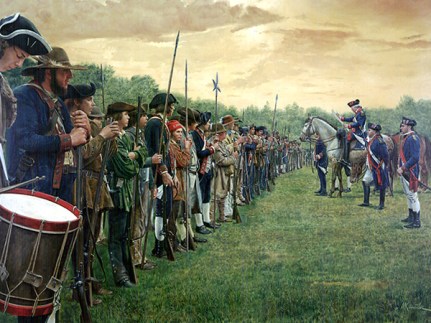
Kunstler_reading-the-declaration-of-independence-to-the-troops

Reading the Declaration of Independence: by Mort Kunstler

In the midst of barbecue, baseball, and fireworks, I encourage you to think for a moment about the men of the 1st Continental Regiment, who on July 4th, 1776 were posted at Gravesend on Long Island, monitoring the British invasion fleet anchored in New York Harbor. When, a few days later, they were read the Declaration of Independence for the first time, they were within cannon range of the most powerful military in the world, and they knew they would pay with their blood, sweat, and tears to enforce that Declaration. But they, with the help of hundreds of thousands of their comrades, did ultimately succeed in enforcing it. Let’s give thanks for their courage and dedication.


To learn more about the effect of the Declaration of Independence, and the darker days of 1776, I suggest reading Times That Try Men’s Souls.

https://www.amazon.com/Times-That-Try-Mens-Souls/dp/1635030420/

Goodreads Giveaway!

Just in time for the 240th Anniversary of the Declaration of Independence, Goodreads members can enter for a chance to win one of three autographed copies of Times That Try Men’s Souls!

Times opens with Gideon Hawke and his comrades listening for the first time to a reading of the Declaration of Independence. The rest of the novels covers the dark days of 1776 when it seemed the British would crush the newborn nation, and concludes with the “Ten Glorious Days” when the resurgent Continental Army staked everything on a few rolls of the dice, and kept the Cause alive!

Goodreads Book Giveaway

Times That Try Men's Souls by Robert Krenzel

Times That Try Men’s Souls

by Robert Krenzel

Giveaway ends July 05, 2016.

See the giveaway details
at Goodreads.

Enter Giveaway


Quill and Ink: Writing the world

As I prepared to commit the act of madness that is called “writing fiction” I poked around to see what others were saying about it. I found that in a lot of genres there was much discussion about something called “creating your world.” It was generally agreed that this was important, and that the author had to walk a fine line in the early chapters of her/his book: the reader had to understand what the world was like, but not be bored by the details. I thought, “That sounds hard. I’m glad I don’t have to do that in Historical fiction.” I was wrong. I have learned that a historical fiction story DOES exist in its own world. There are, however, significant differences between the historical fiction world and the world of other genres.

First and foremost, historical fiction is supposed to be tied into “stuff that happened.” Whether set in Ancient Egypt, Tudor England, the American Colonies, The Napoleonic Wars, the American Civil War, Nazi-occupied Europe, or what have you, there is a historical foundation on which the author builds the “world.” This is harder than it sounds, because history is often a moving target, even though not everyone sees it that way.

Take the Battle of Gettysburg, for example. There is a very solid historical record of the events of that battle; on top of that foundation are layers of storytelling, which sometimes sharpens, and sometimes obscures, the actual events. Many of the critical events in the battle were fairly well known before Michael Shaara released his novel, The Killer Angels. [lest anyone think I am a Shaara critic, I love that book—it has inspired my own writing] Michael Shaara had to make decisions about what to include, and what to leave out or gloss over. The incidents he highlighted he did so dramatically: “Chamberlain’s Charge” and “Pickett’s Charge” for example. When the movie Gettysburg was made, based on Shaara’s book, those incidents lent themselves wonderfully to Hollywood dramatization. As a result, in the common consciousness, our perception of these incidents is colored by several layers of storytelling. A visit to the Gettysburg National Military Park, however, with a knowledgeable guide, might reveal that, well, those things probably didn’t really happen quite that way. Chamberlain’s Charge may not have looked quite so dramatic. Pickett’s Division was probably masked from Union fire until the last 100 yards; that’s how they got as far as they did.

Here’s the real problem: right now someone is taking violent exception to one or both of those last two sentences. History buffs tend to be passionate about their history, and oftentimes once they settle on an interpretation of events, they will defend their position against overwhelming odds…and against overwhelming facts and logic. [Incidentally, I am guilty of this as well] The historical fiction author can expect that any interpretation of events is going to upset at least someone.

Which brings us more to the point: in general, no one can know all of the events and relationships that affected a particular historical incident. The Duke of Wellington famously dismissed efforts to write a history of Waterloo as an impossible task. Even if a person was physically THERE, he/she could have only one, very limited perspective. And when one is talking about events that happened 100, 200, or 2000 years ago, there is an excellent chance that neither the author nor the reader was there.

The bottom line is that it is IMPOSSIBLE to perfectly replicate history. But that’s OK: I would argue that all history is, in fact, the interpretation of past events through the lens of the present. In order for an author to make the past understandable for a contemporary reader, the reader must bridge the gap between past and present; and the author must interpret those events. For me it often involves looking at conflicting sources, or piecing together a picture from incomplete sources, and asking myself, “What really happened? or “Could it really have happened that way?” A good example of this: my portrayal of the Battle of Princeton. Having had a chance to visit the site and walk the field, none of my sources made complete sense. I had to build my own version of the climax of the battle, based on my own knowledge and observations. Did I get it 100% right? Probably not. But I suspect I came pretty close, probably a lot closer than others, and I am happy with the result. Most importantly, I think I conveyed the ideas that Washington made an audacious move, that it was a near run thing, and that it was ultimately a dramatic victory.

That covers major plot points; but what about the overall look and feel of the world? I think most readers picking up a historical fiction book will appreciate that things will be different, so we authors have that going for us. In fact, I think they key is to highlight the critical similarities and differences between THAT world and THIS one. How do people communicate? What do they eat? How does it taste and smell? How do they dress? How do people stay warm/cool? How do they stay clean? Do they even bother? As the reader picks up these tidbits, he or she will subconsciously fit these into his or her existing mental picture of the time period. When done well, the reader consciously or subconsciously finds herself transported to a different time and place. And that is definitely worth the ride!

Times That Try Men’s Souls is available on Amazon at http://www.amazon.com/Times-That-Try-Mens-Souls/dp/1635030420/ or the iTunes Store at https://itunes.apple.com/us/book/id1094687106.

Goodreads Giveaway!

April 19th, 1775: British troops enter Lexington Massachusetts and confront the Lexington Militia. Firing breaks out, and the American Revolution is underway! In honor of this momentous anniversary, Goodreads members can enter to win an autographed copy of Times That Try Men’s Souls!


Goodreads Book Giveaway

Times That Try Men's Souls by Robert Krenzel

Times That Try Men’s Souls

by Robert Krenzel

Giveaway ends May 17, 2016.

See the giveaway details
at Goodreads.

Enter Giveaway


I did it again!

I was mowing again…and worked out the dialogue for the culminating scene of A Nest of Hornets! I did not have my notebook with me, but shortly after finishing the yard work I was able to sketch an outline of the scene. Thank goodness for the notes function on my iPhone! I have enough down to tie the threads together! Now I just have to make the time to write it…

Spring arrives with inspiration in tow

It’s time to mow the lawn again. Some would consider that a bad thing, but I find it enjoyable. For one thing, I plug in my earbuds and enjoy some tunes, but more importantly, I get some of my best story ideas while walking back and forth across the yard.

This past week while about halfway through my front yard I had a flash of inspiration for Chapter 7 of A Nest of Hornets; an excellent plot point to bring a few threads together and perhaps build some suspense. Excellent!

Fortunately I am generally able to remember these ideas I generate while mowing. I dread the day, though, when I get multiple ideas. Maybe I should start mowing with my writer’s notebook in my pocket!