The Shot Heard Round the World

Here once the embattled farmers stood,

 And fired the shot heard round the world.

     –Ralph Waldo Emerson, Concord Hymn

Stand Your Ground

Stand Your Ground, by Don Troiani


On April 19th, 1775 the world changed forever. Tensions between the British Government and its American Colonies had reached the boiling point. For some time British forces had been making forays into the countryside to confiscate weapons and ammunition, and American militia units had been turning out to observe, taunt, and intimidate the Crown’s troops. On this particular morning in Lexington, Massachusetts, the tensions metastasized into violence. As British troops maneuvered to outflank and disperse the Lexington Training Band, which had formed up on Lexington Common, shots rang out. In short order eight Americans were dead and one British soldier was wounded. Word of the shooting spread like wildfire, and soon militia units were converging on Concord, the British objective, and the road from Concord to Boston.

As the British troops were searching the Concord area, a British light infantry force guarding the North Bridge found itself confronted by a strong militia force, which advanced on the bridge. The shooting at Lexington might have been an accident, but what happened next at Concord was deliberate. A few shots were fired, and then a British captain ordered his men to fire on His Majesty’s subjects. Then, in the first formal act of rebellion, a Massachusetts militia officer ordered his men to fire on the King’s troops. That volley was the shot heard round the world. British troops fell, the light infantry retreated, and Great Britain and its colonies were at war.

Minute_Man_National_Historical_Park_MIMA0070

The North Bridge at Concord


In short order the countryside was aflame. Militia forces ambushed the British time and again; they pursued the British column and harried its flanks. At times British soldiers stood back-to-back, loading and firing at fleeting figures and puffs of smoke on either side of the road. At times the British troops simply ran for their lives. By the time the British made it back to Lexington they were in near panic: their ammunition was nearly exhausted and they had miles yet to go. Mercifully for them, a British brigade had marched to their relief and occupied the hills near Lexington. The combined force then battled its way back to Boston, fighting the entire way. As the sun set, campfires sprung up on the hills overlooking Boston and Cambridge: the British garrison was under siege.

When the sun rose over the Atlantic Ocean on April 19th, 1775, it had shed its light on a peaceful countryside. It would be eight years before peace was fully restored in the newborn United States of America.

You can learn about Lexington and Concord from the participants’ perspective in This Glorious Cause.

Robert Krenzel Author Facebook page: https://www.facebook.com/RobertKrenzelAuthor

Gideon Hawke Novels Facebook page: https://www.facebook.com/GideonHawkeNovels/

Over There: One Soldier’s Perspective on other Soldiers’ Wars

FT-17-argonne-19181Last week I was able to catch much of the live stream of the ceremony marking the Centennial of America’s entry into the Great War. It was wonderfully done, reflected multiple perspectives, and offered insights into the impact that moment had on America and the world. The ceremony wrapped up with a rousing rendition of “Over There.” As I hear the lines “We’ll be over, we’re coming over,” I realized I had tears in my eyes. I wondered, “How could a hundred year-old song move me to tears?” I suppose the reason is because my own experience of war gave me at least a little glimpse into what was in store for the young men and women headed “Over There.”

To be clear, between the Balkans, Iraq, and Afghanistan I never set foot in a trench. (Well, that’s not entirely true: in Kosovo I stood in a two-foot deep decoy trench the Serbs dug to draw attention from the well-camouflaged foxholes they had prepared in the woodline nearby.) I never huddled in a shell crater, never endured a sustained artillery barrage, never dodged machine gun fire while negotiating a barbed wire obstacle, was never gassed, and never had my tank break down or get mired in front of the muzzles of several enemy machine guns. That was not my generation’s experience of war.

Our experience was very different. Several years ago I had the great honor of delivering a Posthumous Bronze Star Medal for Valor to the family of a fallen soldier with whom I had served. Before the ceremony I chatted with a few WWII 10th Mountain Division veterans, and I remarked that their accomplishments in Italy were an inspiration to today’s soldiers. I was surprised by the humble reply: “Are you kidding me? We got there in January and the war was over in May; then we were done! You people today go over there for a year, and then you go back over and over again. I don’t know how you do it.”

So it would seem every war is horrible in its own way, and each participant’s experience of war is different. There are moments of horror, but in the midst of the violence and chaos, many, if not most, participants also find moments of valor, excitement, and exhilaration. These highs and lows leave a lasting imprint, and the longer one is exposed to them, them more imprints are left. I think that is true for all wars.

I suppose the most important thing to remember is that when a soldier comes back fromBob and Junood “Over There,” a little bit of “Over There” comes back HERE. Some return better people than when they left. Some returned shattered by their experiences. For most, it is somewhere in between. I can only imagine what went on the minds of veterans of the Great War; I know that I carry a bit of my wars with me wherever I go. If I move over when I pass a broken-down car on the side of the road, it’s to give me room in case the car explodes. If I duck during the weekly tornado siren test, it’s not because I was startled, it’s because in Afghanistan sirens meant a rocket was inbound. If I spend an hour and a half on the phone with someone I’ve not spoken to for years, it’s because at one time he and I were ready to give our lives for each other, and that is a bond that will never be broken.

There is another complicating factor for me: while my military service is over, my wars go on. The dirty roadside where I found my first IED (to be fair, it found me) is still in the hands of Daesh. There is still fierce fighting in Afghanistan. American service members are in harm’s way every day…and I have a son who is seventeen years-old. A hundred years ago he would have been in the target age group to go “Over There,” and I still worry that someday he is going to decide to follow in my footsteps. Maybe that perspective is really why I had tears in my eyes last week.

I did not serve in the Great War and I did not serve in the American Revolution; I can’t claim to know what soldiers experienced in those wars. But I did serve in the Balkans, Iraq, and Afghanistan and I am beginning to understand what I experienced in those places. When I write about Gideon Hawke’s involvement in the American War for Independence, I hope that my involvement in other wars can help illuminate some universal experience of war. Perhaps people will better understand what it means to go “Over There.” If so, then perhaps I will have truly accomplished something.

Robert Krenzel Author Facebook page: https://www.facebook.com/RobertKrenzelAuthor

Gideon Hawke Novels Facebook page: https://www.facebook.com/GideonHawkeNovels/

Historical Figures Great and Small

A great challenge and joy of writing historical fiction is learning about historical figures, both great and small, and working them into my novels. Sometimes I only know them as names on a centuries-old roster, but those names represent real people who once participated in monumental events.

Gideon Hawke is a fictional character. His name, description, and character traits are all products of my imagination. Ruth Munroe is a fictional character, but her surname has roots in Lexington, Massachusetts. By contrast, Andrew Johnston was a real person. I know absolutely nothing about the real Andrew Johnston…aside from the fact that he was one of the original members of Thompson’s Rifle Battalion/the 1st Continental Regiment, he was promoted to sergeant , and [SPOILER ALERT…READERS MAY WANT TO AVERT THEIR EYES] eventually he became an officer, reaching the rank of First Lieutenant on May 12th, 1779. Everything else about him, from the image in my mind to the description on my “character chart,” is fiction, roughly based on my limited knowledge of Johnston’s life and times. Fictional Andrew Johnston is one of my favorite characters; real Andrew Johnston was one of the “winter soldiers” who stayed with Washington during the bad times; through his stubbornness and determination he helped keep the dream alive.

I have recently enjoyed getting to know a few other real characters, all of whom appear in Gideon Hawke #4: A Constant Thunder.

  • Lieutenant Colonel Richard Butler. Butler grew up in his father’s Pennsylvania gunsmith business, and prior to the war was very active in trading with Native American tribes. He was held in high esteem by, and spoke the languages of, several nations, so in the early years of the war he played a key role in keeping some tribes from going over to the British side. He was later commissioned in the Continental Army. A physically strong, hot-tempered man, and pre-war friend of Colonel Daniel Morgan, he served as Morgan’s second-in-command in the Rifle Corps during the Saratoga Campaign. He will play an increasingly large role in Gideon’s life.
  • Captain James Parr. Parr was another original member of Thompson’s Rifle Battalion. When Morgan formed his rifle corps, Parr joined it, commanding the company drawn from the 1st Continental/1st Pennsylvania Regiment. I know very little about Parr aside from his service record. One thing I do know is the tantalizing fact that in the summer of 1777, in small-scale skirmishing, he was personally credited with killing four enemy soldiers in close combat, running at least one through with his sword. Clearly he led from the front! Parr and Gideon will get to know each other very well.
  • Lieutenant Ebenezer Foster. Ebenezer Foster hailed from southeast Massachusetts. He joined the militia in 1777 and served in the Siege of Boston, being involved in the fortification of the Dorchester Heights in March 1776. Commissioned as an officer in the summer of 1777, his service ultimately took him to the Hudson Valley, where he joined Dearborn’s Light Infantry Battalion. Dearborn’s unit worked under Morgan’s command in support of the Rifle Corps. Together, these two units made an incredibly effective team, whose impact at Saratoga was far out of proportion to its numbers. But the price these units paid, especially the Light Infantry, was very dear indeed. In A Constant Thunder, Ebenezer Foster and Gideon Hawke are boyhood friends who meet again in the shadow of great events.

It gives me pause when I realize that I am appropriating the names of people who fought in the great struggle for Independence. I pray that I do them justice. I cannot pretend to be delivering true-to-life portrayals, but I can say I do my best with the information I can find. Perhaps by shedding new light on their names I am at least helping to keep alive their memory I am certainly expressing my gratitude for their toils and sacrifices.

Robert Krenzel Author Facebook page: https://www.facebook.com/RobertKrenzelAuthor

Gideon Hawke Novels Facebook page: https://www.facebook.com/GideonHawkeNovels/

Resources Big and Small: The Internet

“The Internet is like a magic eight ball of the 21st century. You can always get an answer there. It may not be true, but you can always get an answer.”

-Stephen King (http://www.rollingstone.com/culture/news/stephen-king-on-trump-20160609)

Stephen King is absolutely right! The internet is a wonderful resource for writers…you’ve just got to be careful out there!

Much of what you find on the internet these days is garbage. Anyone and everyone can say anything they want about anything they want. Imagine my surprise last week when I was researching a topic and Google pointed me towards a blog post by ME! (talk about an unreliable source!) A fun game you can play is to try to figure out where various website get there information; I find it fascinating how so many pages are simply copy/paste jobs. One user writes something, or copies something from a book or online resource, and then website after website copies the same information verbatim. There is no comment, no assessment, no analysis…just copy/paste. The same questionable material can be reproduced over and over like a virus. (hmmmm…this sounds like the premise for a sci-fi horror novel) When it comes to internet research, it is definitely USER BEWARE!

That said the internet can connect people in new and exciting ways. My favorite recent example: I was doing research on Hudson River navigation in the 1700s, and trying to learn more about the bateau, the “eighteen wheeler / Pullman car” of Eighteenth Century North America. After running into a few brick walls, I stumbled upon a website called The Big Row (http://www.thebigrow.com/), which catalogues the adventures of reenactors who put bateaux through their paces every year. Not only did I learn a great deal, but I also established contact with the websites creator/bateau captain, Dave Manthey! Dave’s insights were invaluable to me in understanding the people and craft of the Hudson and Mohawk Rivers, thus adding authenticity to my work in progress, A Constant Thunder. Persistence and creativity in searching can pay off handsomely!

Then there is the little trick of knowing the resources available. A few days ago I was writing a scene in which Gideon Hawke is an officer of the guard; it is nighttime, and being a good officer he ventures out to check on his sentries. At his first stop he is challenged! The sentry tells him to halt, and challenges him with the “parole” word. “Wait,” I asked myself, “What would be a good parole word?” I considered making something up, but then I remembered that the National Archives, in cooperation with the University of Virginia Press, have digitized a tremendous number of primary source documents from the Founding Fathers. The Continental Army’s daily General Order contained the parole and countersign, so a simple Bing search (sorry, Google, you didn’t find the document I needed) for “General Orders April 18, 1777” brought me to General Washington’s General Orders for the 18th of April, 1777. Boom! When Private George Houseman directs Lieutenant Hawke to advance and be recognized, his challenge doesn’t just sound authentic, it REALLY IS AUTHENTIC! It is the actual challenge used in the American camp at Morristown in 1777. (https://founders.archives.gov/documents/Washington/03-09-02-0180 ; and in case you are wondering, the parole was “Georgia” and the Countersign was “Samptown.”) How’s that for research?

Thirty years ago it would have required a prodigious effort for an author living in the Midwest to gather the kind of information I just discussed. Now it is a few keystrokes and clicks away. I am deeply indebted to folks like Dave Manthey, and the folks behind the keyboards at the University of Virginia Press—by doing valuable work and sharing it online, they are making the internet a useful tool, not just a “Wretched hive of scum and villainy.” I am still very wary of information I find out on the net, but it is definitely worth sorted through the garbage to find the gems.

A Nest of Hornets on Amazon: https://www.amazon.com/Nest-Hornets-Gideon-Hawke/dp/1539953599/


Robert Krenzel Author Facebook page: https://www.facebook.com/RobertKrenzelAuthor

Gideon Hawke Novels Facebook page: https://www.facebook.com/GideonHawkeNovels/

Short Story: A BARREN COUNTRYSIDE (Springfield, NJ; January 6th, 1777)

Is that a ghost? The thing seemed to be both dead and alive at the same time. Under normal circumstances neither word would apply to a small stone farmhouse, but here and now, they seemed most appropriate. The building looked dead because its charred interior, greyish walls, and the gaping windows and doors made it look alarmingly like a human skull. It looked alive because the two windows, the eye sockets, seemed to stare menacingly at passersby; especially passersby with guilty consciences.

Should we feel guilty? The captain wondered as he stared back at the house. Certainly his men had not set this particular house aflame, but how many others had they burned as they pursued the retreating rebel army? There had been many houses like this, each one home to a family, and each family had protested their innocence. None of them, they claimed, were sympathetic to the rebellion. Not that it had mattered. His men, along with so many others, had driven the families out, taken what valuables they could carry, rounded up the livestock, and laughed as the flames destroyed the families’ hopes and dreams.

There had been so much screaming and crying! Many of these Americans had gone too far in their protests, and earned themselves a smash from a musket butt or a thrust from a bayonet. It was harsh. It was terrible. But it was war. Now these Americans had learned the awful price of rising up against their God-given King: slaughter and desolation are the fruits of rebellion.

The captain shuddered against the wind. The dark gray sky and bare trees mirrored his bleak mood. It’s not the bone-chilling cold that’s so bad, he thought, nor is it the mind-numbing weariness. It’s not the fierce hunger pangs. Nor is it the fear of sudden death, or the pervading sense of doom. It’s all of those things combined! That’s what I hate about this miserable country!

The journey from their home in the principality of Waldeck last summer had been a nightmare; the captain had never sailed on the ocean before, and he had really thought the constant sea sickness would kill him. It had taken him and his men weeks to recover their strength in the stifling heat and humidity of Staten Island.

But once they actually started fighting the American scoundrels it had seem this war would turn into something of a lark; every time they grappled with the rebels, the discipline of the sturdy German troops had won the day, and the foe had fled the field. They had chased the Americans off of Long Island, off of Manhattan Island, and into the Jerseys. Here in New Jersey they were finally able to treat the population the way they deserved: brutally. In their wake the armies left almost nothing to sustain the rebellious population through this harsh winter.

Unfortunately, that same devastation was now the biggest problem facing the British command. The plan had been to disperse the armies across the province and leave responsibility for foraging to the local garrison commanders. That would have been so simple! The captain wondered, Who could have foreseen this? Washington’s Army had seemed on the verge of collapse! How had that old fox managed to scrape together enough troops to go on the offensive? In less than two weeks he had crossed the Delaware, captured the Hessian garrison at Trenton, given the British the slip, returned to Trenton, humbugged his British pursuers, and shattered the British garrison at Princeton. Now it seemed that the Allied generals had panicked, pulling all of the British and German garrisons back into a small area in New York and Northern New Jersey.

Unfortunately, the men were now packed so tightly they couldn’t sustain themselves, and because the armies had done such a fine job devastating the New Jersey countryside that they were now having a devil of a time finding enough supplies to survive the winter.

As if the lack of provender were not enough, the Jersey militia had been delighted to see the British and Germans on the run; they been active in November and December, but the news of Trenton and Princeton had made them astonishingly bold! The lack of lodging meant his men had to sleep on the bare ground, and that was uncomfortable, but because of the constant alarms they had to do so fully clothed every night, with their weapons close at hand, ready to turn out at a moment’s notice in the event of militia attack. The men were subsisting on little but salted pork. That was depressing but manageable. The horses, unfortunately, needed fodder, and that had to be acquired from the nearly barren local countryside. That was why they were on the march today.

The captain and his fifty men, plus a dozen British light dragoons, were marching to chase away any militia and seize anything that might serve as horse fodder. With any luck they might catch a local farmer unawares and snatch a bit of fresh meat on the hoof; that would be a wonderful bonus!

The captain’s thoughts returned to the melancholy farmhouse. We are certainly not going to get anything from this farm. Where once animals had grazed and a family had eked out its living, now nothing stirred except a bit of snow drifting in the winter wind. All the while the farmhouse maintained its vengeful gaze.

tree-in-winter

The captain tore his eyes away from the building and looked ahead, toward the troop of dragoons about a quarter mile in front of his infantry. The road here crossed open fields, the stubble of a crop poking through the frost and snow marking what was once cultivated land. The fields were hemmed in on each side by gray, desolate woods. A low stone wall no more than waist-high bounded the field to the front of the horsemen. Beyond the fence was more barren forest.

POP! The captain sat upright on his horse. POP! POP! Musketry! The dragoons wheeled about in the field as puffs of smoke appeared along the wall in front of them. A few of the horse troopers fired from the saddle. What’s happening up there?

The captain spurred his horse forward and before long was up among the dragoons. Their lieutenant asked for permission to retire. Very well. Your task here is done for now. Soon the horsemen were dropping back, and the enemy fire faded away. The captain was now alone in the middle of the field. To his front, near the road, he could see about a dozen American militiamen in civilian clothes skulking behind the stone wall. From about a hundred yards away the rabble seemed immensely pleased with themselves for having driven off the horsemen. The enemy seemed to have no intention of retiring; they must not have seen the infantry yet. Excellent! The men will relish the chance to give this rebel scum the bayonet!

As the dragoons trotted rearward the infantry company deployed into a double line, in open order. The men moved smartly. The captain waited patiently, immobile, while the lieutenants and sergeants kept the men moving forward. They marched steadily, in cadenced step, closing the distance to the rebels. As the company neared the captain urged his horse forward, leading the men on toward the fight.

Once again shots rang out from the fence, and a few balls whistled by harmlessly. The rebels still showed no sign of running. Good! This will be over quickly!

The rebels worked feverishly to reload their muskets and fire at the advancing Waldeckers. The captain was not sure whether to admire or pity such foolish courage. At about seventy-five yards the captain halted his men, dressed their line, and ordered them to fix bayonets. That done, the relentless advance continued. This is too easy! The men might not even have to dirty their muskets by firing! A glance over his shoulder confirmed the dragoons were following behind the infantry, ready to take up the pursuit when the rebels broke and ran. Everything is in place!

The captain was gauging the distance. They were getting very close, almost within fifty yards. The militia had stopped firing; a few finished reloading their muskets. They were so close he could make out the smug, confident look on the enemy’s faces. They were clearly not afraid. What is that about? Why aren’t they frightened? Are they drunk? Don’t they realize we outnumber them almost five-to-one? Or do they know something I don’t?

Just then one of the twelve Americans let out a shout. Almost as one, about a hundred American militiamen rose from behind the stone wall. The captain froze, his mouth agape. It seemed to him that time slowed to a crawl. In perfect unison the rebels made ready and leveled their muskets. Then a wave of flame and smoke erupted from their line, and dozens of lead balls smashed their way through the company.

The first volley snapped the Waldeckers into action. The officers and sergeants started barking orders. Miraculously none of the leaders were down, but several of the men were sprawled on the ground or staggering rearward. As they had trained to do so often, and had done in earnest on several occasions, sergeants yelled and shoved to get the men to quickly close the gaps in the line. In no time the company was trading volleys with the militia. His men were much faster at loading and firing, but were hindered by the bayonets fixed to their muzzles. They were also fully exposed. In contrast the militia had the advantages of numbers and the stone wall. The wall would make the difference; over time more rebels than Waldeckers would survive the exchange. It was simply a matter of mathematics. A quick glance at his line told the captain that his company was in mortal danger. He has led them right into a trap, but perhaps a bayonet charge would save the day. Perhaps, just perhaps, one quick rush would break the Americans or at least buy him time to…ZIP—THUD!

The captain felt as though he had been punched in the gut. I’ve been shot! He felt the wound and then stared at the blood on his gloved hand. One of the lieutenants rode up and asked if he was badly hurt. Should I hand over command? Another ZIP was followed by a CRACK, and the lieutenant fell from his horse with a gaping hole in the side of his head. Something caught the captain’s eye, and he looked up at the forest off to the right flank of his company. There, about a hundred yards away, a puff of smoke! ZIP—THUD! Another bullet slammed into the captain’s thigh. Rifles! He hadn’t considered that. The captain took a last glimpse at what was left of his company. Half of the sergeants had fallen, and the hidden riflemen were singling out the rest. Nearly leaderless, the men who could still do so started running for their lives. Good, maybe some of them will escape. As his command disintegrated, the captain slid off his horse and fell in a heap on the iron hard ground. That should have hurt, but I hardly felt it! I must be in a bad way.

The captain was distracted by figures rushing by. He struggled to make sense of what he was hearing and seeing. He snatched a moment of clarity: the figures were American militiamen chasing his infantrymen. Run lads, run! Get away from these people!

The captain tried to rise, but collapsed back onto the ground. I am so tired. He laid on his back, rested his head on the ground, and gazed at the steely gray clouds, low in the sky overhead; the clouds reminded him of Waldeck. It’s strange how we can be so far away from home, but have the same clouds overhead. Suddenly his view of the sky was blocked by a wide-brimmed hat. Confused, the captain focused on the form looming over him. It took a moment to make out the face staring down at him. It was an American provincial, squatting over him, leaning on a musket. “Well, you’re clearly not British, are you?” the man asked, “German?”

The captain nodded weekly. His English was not so good, but he managed to follow as the man went on.

“Well, Mister German,” the American said with a grin, “Wilkommen in New Jersey!”


This short story started as a prologue for Gideon Hawke #3, A Nest of Hornets.


The Forage War

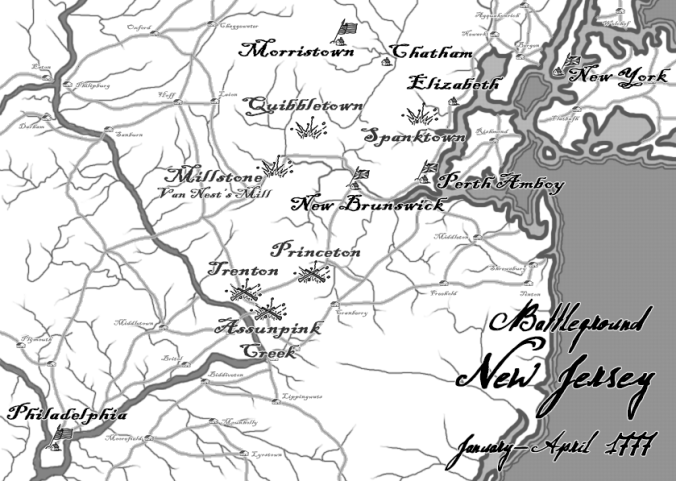
The British plan for the winter of 1777 had been to disperse their brigades across New Jersey, where the units could live off the land to augment the tenuous cross-Atlantic supply line. George Washington’s recently proven proficiency at destroying isolated brigades made this plan untenable, so the British and their German allies retreated to a few massed positions in New York and New Jersey. This gave them security, but left the countryside in the hands of the Jersey Militia, who had been freshly galvanized by the American victories in the Ten Glorious Days. Now the British and Germans would have to send out fighting patrols in ever increasing numbers to forage for food and fodder. These foraging parties made attractive targets for increasingly large swarms of militia, soon reinforced by Continental troops.

nj

Here are just a few of the 50-60 “skirmishes,” with the forces involved:

  • January 6th: Springfield, NJ. A force of 50 Waldeck (a German principality) infantry and a few British light dragoons ambushed and captured. This action precipitated the British abandonment of Elizabethtown (modern Elizabeth, NJ).
  • January 20th: Van Nest’s Mills (Millstone), NJ. 500 British, reinforced with with artillery, were attacked by Brigadier General Philemon Dickenson and about 400 militia, reinforced by a company of Continental riflemen. The British were driven off with heavy loss, to include a wagon train and several dozen head of cattle.
  • February 1st: Drake’s Farm. A force of about a thousand British and Hessian troops, to include elite battalions of light infantry, grenadiers, and highlanders, attempt to set a trap for an American force. When the 5th Virginia Regiment tries to capture a small party of British foragers, they are surprised by the entire British force.  The Americans launch a bayonet charge which breaks the grenadier battalion and buys them time to make good their escape.
  • February 23rd: Spanktown (Rahway) NJ. Nearly 2000 British regulars under the command of Lieutenant Colonel Charles Mahwood, the British commander who nearly won the day at Princeton, attack a small American foraging party. As they launch what they expect to be a final assault they are ambushed by nearly 2000 previously hidden Continental troops. The British are driven from the field and pursued back to their fortifications in Amboy.

The Continental troops gained experience and confidence from these encounters. They would later put their new-found expertise to good use at Brandywine, Germantown, and Saratoga.

The British and Germans realized that this was going to be a long, hard war. Perhaps a few of them began to develop a new-found respect for their ragtag opponents. If nothing else, it seemed in the words of one British officer that an outing into the New Jersey countryside was like walking into “a Nest of Hornets.”

You can experience the Forage War from a participant’s perspective in Gideon Hawke #3: A Nest of Hornets!

A Nest of Hornets on Amazon: https://www.amazon.com/dp/B01NBI511Q/

Ten Glorious Days!

December 25th, 1776 through January 3rd, 1777: ten pivotal, and glorious, days in American History.

The second half of 1776 very nearly saw the British and their Hessian allies crush the newly independent United States. Some of the American troops on Long Island learned of the Declaration of Independence while they were within sight of the British fleet anchored in New York Harbor. A few weeks later the British would overwhelm the American defenses on Long Island, triggering the first in a series of retreats that would see Washington’s Army nearly melt away; when the remnants finally crossed the Delaware River into Pennsylvania, Washington had immediately available only about 10% of the force he had in August. But “The Old Fox” did not give up. He set to work reconstituting his army, calling in detachments, seeing to it the sick and wounded were nursed back to health, persuading troops to stay with the colors, calling upon Congress and the states for reinforcements, and restoring morale: he ordered Thomas Paine’s The American Crisis read to the troops.

These are the times that try men’s souls. The summer soldier and the sunshine patriot will, in this crisis, shrink from the service of their country; but he that stands by it now, deserves the love and thanks of man and woman. Tyranny, like hell, is not easily conquered; yet we have this consolation with us, that the harder the conflict, the more glorious the triumph. What we obtain too cheap, we esteem too lightly: it is dearness only that gives every thing its value.

Washington knew that having an army was not enough: in the dark times at the end of 1776, he had to DO something with that army to give his countrymen hope. He knew he could not confront the enemy on even terms, but he also knew that the British and their Hessian allies had grown complacent in victory. He looked for a weakness, and found it across the River: in Trenton, New Jersey.

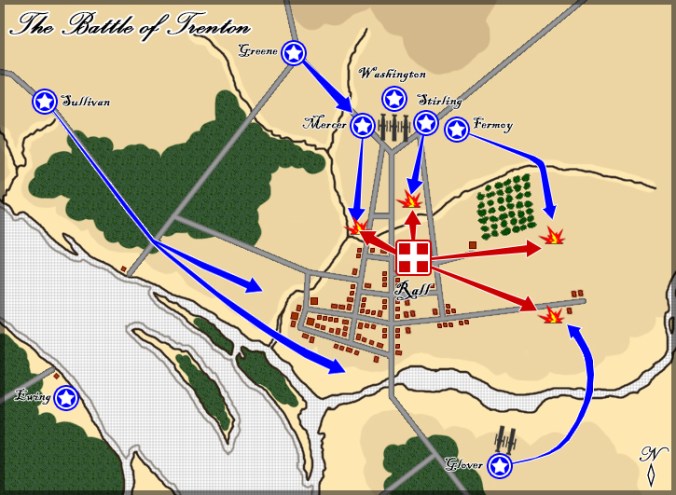
The Hessian brigade stationed in Trenton was alert, disciplined, and well trained, but it was increasingly isolated. On the night of December 25th, 1776, in a blinding snowstorm, Washington personally led his most reliable units across the ice-choked Delaware and on toward Trenton. None of the supporting attacking columns managed to cross the river, but Washington drove the main force on, and just after dawn on December 26th his men surged around Trenton. After a short, sharp fight most of the garrison surrendered. Only a few Hessian jaegers and British dragoons escaped, because they fled at the first alarm. Now isolated himself, but having won a precious victory, Washington withdrew back across the Delaware before the British could counterattack.

battle_of_trenton

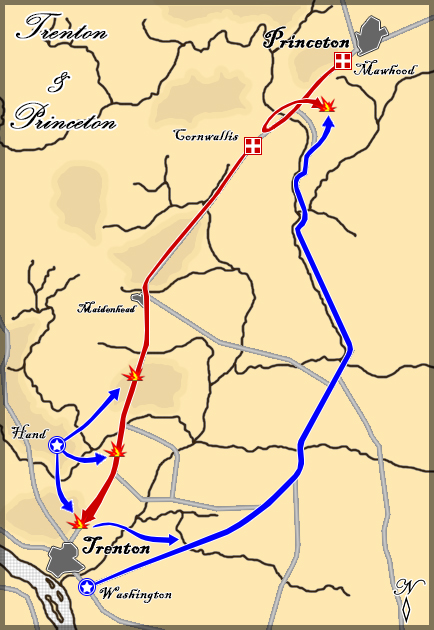
The enemy response bordered on panic. The British command pulled in their far-flung garrisons across New Jersey and assumed a defensive posture, giving Washington total freedom of movement. Seeing another opportunity, Washington crossed the Delaware again and took up defensive positions along Assunpink Creek, just south of Trenton. When her learned that British General Charles Cornwallis was on the march toward Trenton, Washington deployed a screening force to the north to find and delay Cornwallis: this force included the First Continental Regiment, commanded by Colonel Edward Hand. Once the enemy appeared just south of Princeton Hand took command of the screening force; falling back from covered position to covered position his men slowed the British to crawl and inflicted galling casualties, buying time for the main force to improve the defenses on Assunpink Creek. As night fell Hand’s force fell back through Trenton and scrambled across the only bridge. The British attempted to seize the bridge, but the attackers were swept away by a storm of musket and cannon fire. Cornwallis’ force settled in for the night, prepared to renew the attack in the morning.

princeton_and_trenton

Washington had learned a great deal since Long Island. He knew Cornwallis would attempt to outflank him in the morning, and he knew that maneuver would probably succeed. So, he left a small force to keep the watch fires lit, make noise, and fire the occasional cannon; with the rest of his army Washington quietly marched away in the dead of a pitch black night, slipped around Cornwallis’ flank, and marched northwards toward Princeton.

Cornwallis had been so confident he had summoned most of the Princeton garrison, under Colonel Charles Mahwood, to march to Trenton. Part of Washington’s force, under Hugh Mercer, ran into Mahwood’s men, and a fierce fight ensued. Mercer was killed, his brigade broken, and Mahwood nearly broke the American line, but Washington rallied his men, and the line held long enough for another force, including Hand’s riflemen, to fall upon the British left flank. Mahwood’s units broke and ran, and while some of Washington’s force hunted them down, the rest moved into Princeton to capture the rest of the garrison. When Cornwallis finally arrived at Princeton, Washington’s force was on the road to the relative safety of the rugged terrain around Morristown with prisoners, captured guns, and loot in tow.

princeton

In ten days what seemed to be a defeated force had turned the tables, knocking two brigades out of the enemy order of battle, but more importantly breathing new life into the American cause and sowing fear in the hearts of their enemies. The New Jersey militia came out in swarms, and the British soldier had to endure a long, bitter winter marked by cold, hunger, and constant danger. In order to feed themselves, the British and Hessians would have to venture out into the Jersey countryside, where they knew their enemies were waiting in ambush. There would be many more battles to come.

To see the Ten Glorious Days from the perspective of one of the participants, check out Times That Try Men’s Souls!

Artwork by Ben Kloeppersmith

Washington Crossing State Park: https://www.nps.gov/nr/travel/delaware/was.htm

The Old Barracks Museum, Trenton: http://www.barracks.org/

Princeton Battlefield Society: http://www.theprincetonbattlefieldsociety.com/

The Plot Thickens: Rowing Upstream

As I waited to receive the proof copy of A Nest of Hornets I found myself inevitably drawn to working on Gideon Hawke #4, A Constant Thunder. I have already written several scenes, or at least the shells of those scenes, but I still have a lot of work to do on sketching out the flow of the novel. I had identified the chapters and was trying to flesh one of those chapters out when inspiration struck with a glance at a map.

It is no secret that Gideon Hawke will find himself in Daniel Morgan’s Provisional Rifle Corps, and thus will move north to confront Burgoyne’s “Canadian Army” in late summer of 1777. I had intended to focus one chapter on the movement north. I had a sketchy idea that there were boats involved at some point in that undertaking, but I had not yet tried to envision how that journey looked. So, last week I sat down to try to sort out how Morgan’s Rifle Corps got to the Albany area.

Hudson emplacementI knew the destination, so the next step was to identify the starting point. In poking around I discovered that Morgan’s headquarters was in the Hackensack, New Jersey area around the time Washington ordered Morgan to join the Northern Department. Having start and end points, I looked at the map and was hit with a blinding flash of the obvious: Hackensack and Albany both lay along the Hudson River. Given the primitive condition of the American road network in the 1770s, the fastest, cheapest, and easiest was to get five hundred men and assorted family members the roughly 130+ miles between these two points would have been to move straight up the Hudson.

The watercraft of choice in late Eighteenth Century America was the bateau: a flat-bottomed, shallow-draft vessel ranging in length from under twenty to over eighty feet in length. These craft carried both passengers and cargo, could maneuver in shallow water, and were relatively easy to transport overland. They could be propelled by sail, pole, or oar, and were critical to commerce and transportation in Colonial and Revolutionary America.

Before this I had never paid much attention to the lowly bateau, even though it features prominently in any discussion of the Saratoga Campaign. But now I find myself rearranging A Constant Thunder to include several chapters describing a bateau journey upstream. Not only will this be a great way to highlight a little understood aspect of life in Revolutionary America, but it will also serve as a metaphor on several levels. Without giving too much away, I am thinking about questions like: Who is in that boat with Gideon? What challenges does such a journey present? What other challenges might Gideon and his fellow characters face? What other life journeys might Gideon be on? What awaits at the end of the journey? What goes through a young man’s mind as he sails (or rows) day after day? Is this journey a trial, a quest, or both?

Writing historical fiction can be full of surprises. Occasionally a seemingly inconsequential bit of research can turn your story on its head. In this case, a glance at a map opened up an entirely new adventure.

Robert Krenzel Author Facebook page: https://www.facebook.com/RobertKrenzelAuthor

Gideon Hawke Novels Facebook page: https://www.facebook.com/GideonHawkeNovels/

Tedious but Enlightening Research

As I have said before, one of the great challenges of writing historical fiction is GETTING IT RIGHT! While it was a treat to visit the Saratoga Battlefield, research is not all fun in the sun!

For the first three novels in the Gideon Hawke Series I was fortunate enough to find print books with rosters of the actual units to which I assigned Gideon Hawke. Those days are over! In Book 4, A Constant Thunder, Gideon and a few of his comrades decide to join Morgan’s Provisional Rifle Corps. In doing so they march into a unit for which records are scarce! We know a great deal about the exploits of Morgan’s Riflemen, but rosters are difficult to come by, and the sources available are often incomplete or contradictory. The most helpful source I have been able to find is a list of participants in the Battles at Saratoga prepared by Heritage Hunters of Saratoga County, NY. It is a lengthy list, not quite complete, but it provides basic information on known participants. For example:

WRIGHT, Barrick             NY

             Drummer, Capt. Wright’s co., Col. Van Cortlandt’s regt., from 14 Jan 1777 to Jan 1782. 

So, I went the tedious exercise of pouring through tens of thousands of names looking for the phrase: “Captain James Parr’s co.; Col. Morgan’s Battalion.” I don’t think the list is quite complete: I only came up with 32 names, including Captain Parr, a sergeant, a corporal, and a few dozen privates; other sources claim Parr marched with a few lieutenants and 50 enlisted men. There are also a few discrepancies in the assignments of a few other members of Morgan’s Rifles: in one instance, Private Timothy Murphy is listed as belonging to Captain Hawkins Boone’s Company, but other sources indicate he was in Parr’s Company. While there may be a few inaccuracies, I am confident I have gotten a feel for the actual men who marched north in August, 1777 to reinforce the Northern Department against Burgoyne. This was a long and tedious exercise, but it had unintended benefits. You see, an exercise like this yields fertile ground for an author with an imagination. Here is one example:

CHURCH, John                   CT          

              Served under Gen. Arnold; helped Arnold from his horse when he was wounded at Saratoga.

Additional military information: Served under Arnold at Quebec, 1775. Other: He was born 1755 in Chester CT; died 1834 in Winchester CT. He married Deborah Spence, 1780; they had at least one son, Isaac who married Sylvia Maria Clark and one daughter, Lucy, who married Asa Gilbert Olds.  He was placed on pension in 1832, for over nine month’s actual service as private in the Connecticut troops.

Now, I have walked on the very spot behind the Breymann Redoubt where Benedict Arnold was wounded, so Private Church and I have trod upon the same ground, albeit separated by 239 years of time. For me having this bit of information makes Private John Church a fascinating and familiar character. I am not quite sure how yet, but I am certain he will have a cameo in A Constant Thunder.

More importantly for me, reviewing this list of names has brought me closer to the subject matter by making Saratoga very much more personal. I did not originally want to engage in such a tedious task, but once I did I stumbled upon poignant entries such as this:

EASTMAN, Joseph             NH

              1st N. H. Regiment.  Died 30 Oct 1777 of wounds received at Saratoga.

This entry provides very little information about Joseph Eastman, other than his name and unit, but I know enough about the clashes at Freeman’s Farm and Bemis Heights to know that on both occasions the 1st New Hampshire Regiment went toe-to-toe with the best the British Army had to offer, and it covered itself with glory. I also know enough about those battles and about 18th Century medicine to deduce that Private Eastman fell on October 7th, 1777, and endured over three weeks of agony before succumbing to his wounds. I also found hard evidence confirming that the regiments heavily engaged at Freeman’s Farm and Bemis Heights paid dearly for their role. The list is replete with members of units like the 1st, 2nd, and 3rd New Hampshire Regiments, Dearborn’s Light Infantry, or the Albany County Militia, who suffered many killed or mortally wounded on September 19th and October 7th, 1777.

It is my sincere hope that in some small way A Constant Thunder will help preserve the memory of soldiers like Drummer Wright, Private Church, and Private Eastman: Americans who fought in fields many miles from their homes, and who in many cases gave what Lincoln called “the last full measure of devotion.”

Many thanks to the men and women who did the inglorious work of preserving, compiling, and organizing these data, helping to preserve the legacy of the Americans who fought their fledgling Nation’s independence along the banks of the Hudson in 1777.

Heritage Hunters of Saratoga County, NY: American Participants at the Battles of Saratoga: http://saratoganygenweb.com/sarapk.htm#Top

Robert Krenzel Author Facebook page: https://www.facebook.com/RobertKrenzelAuthor

Gideon Hawke Novels Facebook page: https://www.facebook.com/GideonHawkeNovels/

Musical Inspiration

Sometimes my imagination needs a jump start. Sometimes it needs some help keeping it “in the zone.” Sometimes it just needs a taste of the historical period I am writing about to keep the juices flowing. At times like these music is my source for inspiration. I know some writers prefer to write in absolute quiet, but not me!

I have managed to find a number of albums from Fife & Drum groups; these are excellent for taking me back to the Eighteenth Century. I find these especially useful during the action scenes, when Gideon Hawke and his mates are trading shots with the British or Hessians. While in the Army I participated in enough ceremonies to understand the power of martial music over a group of soldiers, so when I wrote one of my favorite scenes, the fight on Breed’s Hill (a.k.a. the Battle of Bunker Hill), I had The British Grenadiers playing on a continuous loop. The effect was so profound I included a snatch of the tune into the text, and I got in the habit of including the “rat-tat-tat” of the drums urging the British forward.  Of course, when I write scenes in which the Americans have the upper hand, there is no substitute for Yankee Doodle! That song was born as a British insult toward the American “Provincials” but was embraced by the Americans and became a symbol of American resistance. Many a British soldier fell on the battlefield to the accompaniment of Yankee Doodle.

But it’s not all fifes and drums, of course! I also have a couple of go-to contemporary (-ish) groups and artists whom I can rely upon to help me focus. I find that Lord Huron, with their sweeping instrumentals, smooth vocals, and gritty lyrics help me put my world aside focus on Gideon Hawke’s world. (I am listening to them right now, in fact!) What’s more, I can always count on their song She Lit a Fire to help me get in touch with Gideon’s feelings for Ruth. On the other hand, I think Brother brilliantly captures the emotions that men feel toward one another as they face hardship or combat together; that song reminds me of the relationship between Gideon and Andrew Johnston.

When I need to slow things down a bit, or feel especially inspired, Sarah McLachlan never lets me down. If nothing else I find that her incredible talent helps me to de-stress. When I am exploring characters and relationships, Sarah’s music helps me get in touch with a completely different set of emotions. She also throws in a few curveballs; her song Monsters was one of the inspirations behind the character of Kate Scott, who makes quite a splash in my forthcoming novel A Nest of Hornets.

Of course, it was not all fun and games during the Revolution. War takes a toll, and I find that many of the songs on the Dire Straits album Brothers in Arms evokes those feelings of war-weariness and loss. (Yes, I realize I just dated myself, and I’m OK with that!) I feel the title song brilliantly communicates the feelings of brotherly love in extremis.

There are many more, of course. Were someone to browse my musical selections I am sure the term “eclectic” would come to mind (or perhaps something a bit harsher). Whether it’s rock or reggae, Buffet or the Beatles, AC/DC or the Maytals, it all has a place, and I am certain that the flavor of the music comes through on the pages. I hope my readers enjoy the beat!

I am curious to hear what music inspires other authors, or if readers have favorite background music to accompany a good a good book. What say you?


Robert Krenzel Author Facebook page: https://www.facebook.com/RobertKrenzelAuthor

Gideon Hawke Novels Facebook page: https://www.facebook.com/GideonHawkeNovels/