This is a topic that is very important to me, but which can be very difficult to discuss.
As a career soldier I served on six operational deployments, including two tours in Iraq and one in Afghanistan. Each of those experiences left me forever changed; in some ways for the better, and in some ways, well, not. When I set out to write historical fiction set in the American Revolution I am not sure I realized how cathartic it would be for me. One thing is certain: after I dragged my protagonist, Gideon Hawke, through the wringer a few times I started to think, “This sixteen year-old is going to have a hard time dealing with all this.” Perhaps unconsciously this helped me to highlight the effects war has on its victims and participants.
For the record: the 1770s were a very different time, and the American Revolution was a very different war from what we experience today. There were a few factors which may have contributed to lessening the effects of what we now call Post-Traumatic Stress (PTS) on Eighteenth Century soldiers. First of all, society was different. There was more of a sense of community; people were more likely to pass their time in each other’s company than alone. Without television, radio, the internet, or mobile devices, people were less likely to seek “alone time.” As Sebastian Junger points out in his recent book, Tribe: On Homecoming and Belonging, the isolation of late-Twentieth and early-Twenty-First Century life has contributed significantly to the impact of PTS in our society.
Secondly, death and injury were far more common. In modern America a person can easily go through life happily munching away on poultry, pork, and beef without ever seeing an animal slaughtered. Likewise, except in certain areas it is an anomaly to see a dead human body. Again, Colonial/Revolutionary America was different. Infant mortality was much higher, life was shorter, and more people lived off the fruits of their labors. Certainly the industrialized meat packing industry was non-existent, so people were more accustomed to seeing blood spilled. People in general were less sensitive to some forms of potential trauma.
Furthermore, many American Revolutionary War soldiers served short enlistments, meaning that they would be exposed to military life for only a short time and then return home. They might serve in the war again, or they might not. Some served long stints, but most did not; we now know all too well about the compounding effects of multiple, extended, repeated exposures to trauma. Many of my friends have, like me, served long stints in dangerous conditions, over and over again. Some Revolutionary War soldiers, like Gideon Hawke, did serve for extended periods, and paid the price.
 Regardless of how different society may have been in the 1770s to 1780s, people were still people, and war was still war. The human body reacted to danger and near-death in essentially the same way. So, when people in the 1770s and 1780s were exposed to trauma, many exhibited symptoms of would today be labeled PTS: insomnia, nightmares, nervousness, hypersensitivity, gastrointestinal issues, substance abuse, hearing voices, suicide, and so on. There were other manifestations which are less common today. For example, soldiers who had killed enemy combatants in hand-to-hand combat sometimes reported seeing the “ghosts” of their vanquished foes. But many of the symptoms would be very familiar to a modern combat veteran. Whatever the symptoms, science had not yet come to terms with PTS, and had not made the link between, for example, a soldier’s honorable service and behavior that could be viewed as bizarre if not frightening. The closest contemporary science may have come was applying the term “nostalgia” to this condition; it implied a link to homesickness, and did nothing to help those suffering from PTS.
In the Gideon Hawke Series I have endeavored to show the effects of PTS in my characters. While he is often euphoric during combat, afterwards Gideon suffers from insomnia and nightmares; he is sometimes physically ill after an engagement; he is occasionally unable to control his emotions; he has contemplated suicide. His friend, Andrew Johnston, also suffers from insomnia, but in addition he sees the ghost of an Indian youth he stabbed to death many years prior. In my work in progress, her work in a military hospital is beginning to take a toll on Gideon’s love, Ruth Munroe. The war will continue to take a toll.
Believe it or not, it is hard for me to see these characters suffer from their invisible wounds (they do live in my head, after all). But in spite of any sympathetic reservations I might have, I feel obligated to see to it that they suffer, if only to honor the invisible wounds suffered by so many of my brothers and sisters in arms. Myself included.
To experience the effects of Post-Traumatic Stress through the eyes of Gideon Hawke, I suggest reading Times That Try Men’s Souls. https://www.amazon.com/Times-That-Try-Mens-Souls/dp/1635030420/
To learn more about the effects of Post-Traumatic Stress in modern combat veterans, or to get help for yourself or someone you love, I strongly recommend the non-profit organization Invisible Wound. https://www.facebook.com/InvisibleWound/

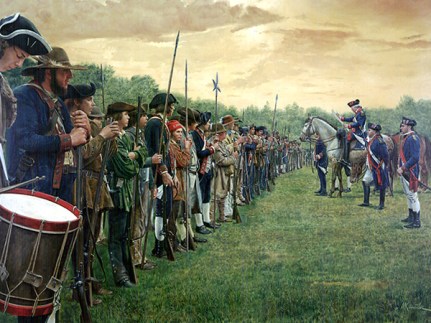

 Robert Krenzel